When the Dead Speak - Autopsy Evidence in Medical Negligence
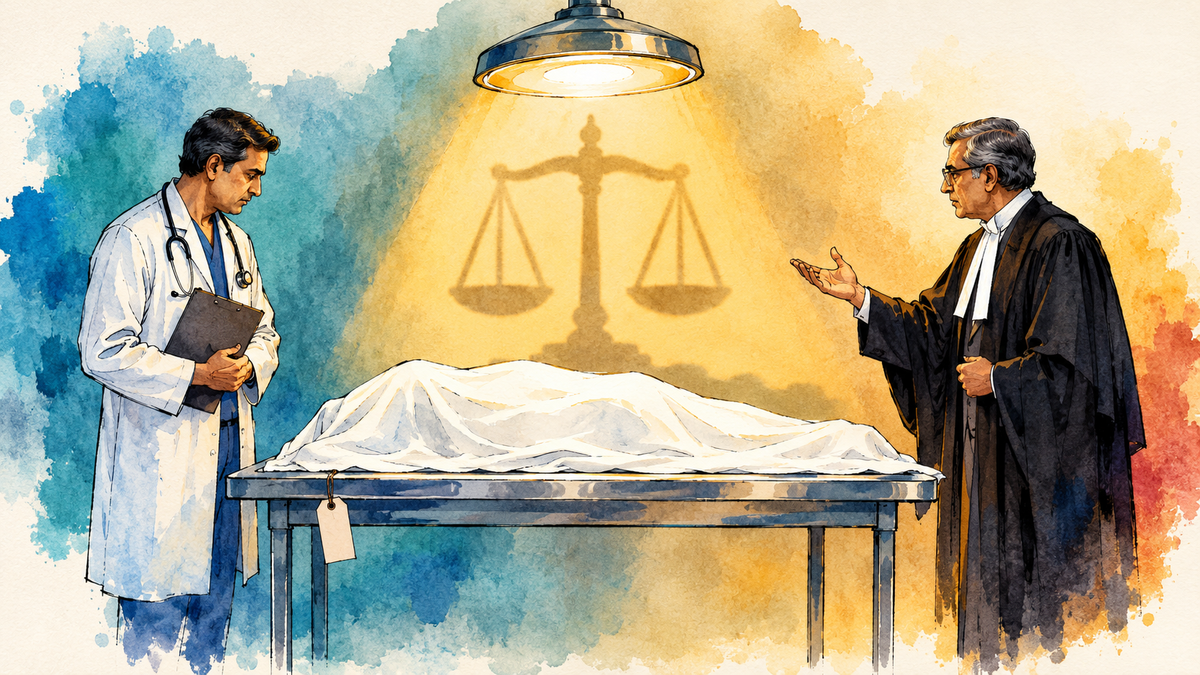
"The dead have never bothered me. It's the living that I fear."
— Patricia Cornwell
When the Dead Speak: Autopsy Evidence in Medical Negligence
Post-mortem reports are challenged more and more often these days. That tells us something uncomfortable: people are losing faith in the doctors who perform them. When a family suspects that the report has been written to protect a colleague rather than to reveal the truth, the integrity of the entire process comes into doubt.
For the victim's family, this is no small matter. In a criminal complaint against a doctor, the complainant needs expert evidence to support the case, and finding a doctor willing to testify against another doctor is almost an impossible task. The only avenue left open is the post-mortem report, provided it is truly independent. If that door is also closed, the victim has nowhere left to go.
Key Takeaways
- A post-mortem establishes identity, time of death, and the cause and manner of death, and each of these can expose negligence.
- "Cardio-respiratory arrest" is the final event in every death; the real question is what caused it.
- Forensic medicine experts are fully competent to distinguish natural disease from iatrogenic injury, so their opinion is genuine expert opinion.
- Deaths in hospital that raise suspicion should be examined by a panel, under full videography, with the preliminary report made available to the family.
- Investigating officers must ask specific, pointed questions of the autopsy surgeon; casual questions produce casual answers, and casual answers produce acquittals.
Why the Post-Mortem Matters
The purpose of a post-mortem is threefold: to establish identity, to determine the time of death, and to find the cause and manner of death. In a medical negligence case, each of these can become decisive.
Identity
When the wrong body is handed over to the relatives, it is itself a case of medical negligence. During the post-mortem, this question can be settled conclusively by a DNA test. There is no excuse for doubt.
Time of Death
Time of death is far more important than most people realise. In many cases, doctors and hospitals stage a last-moment drama: the patient, already dead, is put on a ventilator, shifted to the ICU, given costly injections, even subjected to open cardiac massage. Why? For money. A properly conducted post-mortem that fixes the time of death exposes this deception immediately.
Cause of Death
In most cases, the cause of death offered by the accused doctor is "cardio-respiratory arrest." The doctor then explains at length everything he did after the arrest: the resuscitation, the drugs, the efforts. But the question is not about his efforts. The question is: what caused the cardiac arrest in the first place? Arrest is the final event in every death. Declaring it as the cause explains nothing.
When an Autopsy Is a Must
Gradwohl's Legal Medicine is clear on this point: an autopsy is essential when death is sudden, unexplained, unexpected or violent, and it must be undertaken where death may have resulted from criminal acts or from hazardous procedures adopted in medical practice.
A death on the operation table or shortly after an anaesthetic falls squarely within this description. When the treating doctor is not in a position to certify the cause of death, he is duty-bound to inform the police, and a post-mortem must follow. The consent of the relatives is not required for a medico-legal post-mortem.
How the Report Should Be Prepared
Ordinarily, the autopsy surgeon forms an opinion on the cause and manner of death from the findings of the external and internal examination of the body. In cases of alleged medical negligence, this is not enough. I recommend the following:
- The post-mortem should be performed by a panel of doctors, not a single medical officer.
- The entire procedure should be recorded on video, and photographs should be taken of every abnormal finding.
- The panel may also examine the medical records of the deceased's treatment, since the findings on the table must be read against what the hospital says it did.
It hardly needs saying that the forensic experts on this panel are skilled and knowledgeable doctors in their own field, "Forensic Medicine", just as the accused doctor is in his.
The "Not a Specialist" Argument
A baseless argument is often put forward by the accused doctor: the autopsy surgeon, even one with an MD in Forensic Medicine, is not a surgeon, not a gynaecologist, not an anaesthetist, and therefore not a specialist in the subject in question.
This is simply wrong. The forensic expert knows very well which ante-mortem injury is the natural consequence of the disease the deceased suffered from, and which injury is iatrogenic, that is, caused by the doctor. He is fully competent to give an opinion on whether death resulted from the natural course of disease or from an iatrogenic injury. Recognising the difference is the very heart of his discipline.
It is true that at the district level, post-mortems are usually performed by MBBS doctors. But the MBBS syllabus in Forensic Medicine now includes a chapter on deaths during surgery and anaesthesia, so even a medical officer knows how to conduct a post-mortem in a hospital death and how to report it. They receive training for this as well. It can therefore be safely said that every post-mortem report is prepared by a competent doctor and deserves to be treated as expert opinion.
The Victim's Dilemma: Two Courts, Two Standards
Here lies the victim's dilemma. Consumer Commissions are often reluctant to give a post-mortem report its real weight, and they find one reason or another to set it aside. Criminal courts, on the other hand, routinely treat the post-mortem report as genuine expert opinion in cases of murder, homicide and bodily injury. Why should the same document carry weight when a knife caused the death, but lose it when a scalpel did?
It is said that an experienced judge can read between the lines of any expert report. Like any other expert report, a post-mortem report does not bind the court, particularly when it is inconclusive, biased, prepared by an unqualified person, or supplied after a long delay. That is fair. What is not fair is dismissing a sound report simply because the accused happens to be a doctor.
The Danger of Manipulation
We must face a hard fact. Accused doctors are often influential. They can easily pressurise the doctor performing the post-mortem, by all means available, to manipulate the report in their favour. And often, they do.
To remove every doubt about manipulation, I propose:
- Complete videography of the entire post-mortem procedure.
- A primary report of the clinical and physical findings, together with the video recording, to be sent to the competent authority within 24 hours.
- The final report, with opinion, to follow within a reasonable time thereafter.
- The primary report to be treated as a public document, with a copy given to the victim's family, for complete transparency.
When the findings are fixed on record within a day, there is little room left to rewrite them later.
The Duty of the Investigating Officer
Most of the time, the investigating officer, seeking expert opinion, asks casual questions of the autopsy surgeon and receives casual answers. Meanwhile, the court insists on proof of a specific act or omission amounting to gross negligence, the standard the Supreme Court laid down in Jacob Mathew v. State of Punjab, (2005) 6 SCC 1. When the investigation fails to identify that act, the doctor is acquitted. A Special Investigation Team headed by an IPS officer who is also a doctor would go a long way toward solving this problem.
The officer must ask specific questions, such as:
- Was any predisposing factor overlooked by the treating doctors?
- Was there an unusual amount of blood, pus or fluid in any body cavity?
- Was there anything unusual at the operation site or in the area of anaesthesia?
- Was anaesthesia properly induced? Were there signs of hypoxia?
- Did death result from a failure to monitor the patient?
- What was the condition of the respiratory tract, the heart, the lungs and the spine?
- Was any major blood vessel ligated or cut?
- Was any structure such as the ureter or the bile duct ligated?
- Was there any abnormal leakage or perforation? Was any organ removed?
- Was the operation, and the anaesthesia, really necessary? Would the patient have died without it?
- Was there any defect in the surgery or anaesthesia? Did that defect amount to gross or very serious negligence?
- Could it have been avoided with due care? Was it the cause of death?
This list can be adapted, with modifications, to almost any case. Of course, the grieving family may wonder why all this show is needed. Why not simply ask: was it a blunder, and did that blunder cause the death? The answer is that courts convict on specifics, not on sentiment. Precise questions yield precise expert answers, and those answers arm the Public Prosecutor with the evidence he needs.
Conclusion
A genuine post-mortem report is like a time machine. It carries us back to the final hours, shows clearly the cause and manner of death, and can throw light on the negligent acts and omissions of the accused in those last minutes. But a time machine is only as reliable as the hands that operate it. Panel autopsies, full videography, a primary report within 24 hours, and a transparent record given to the family are what keep those hands honest.
The dead cannot speak for themselves, but the post-mortem report can speak loudly about the ante-mortem injuries that resulted in death, if only we allow it to.
About the Author
Dr. Mahendra K. Joshi, M.S. (General Surgery), LL.M. (Criminology), M.A.S.L.M.E. (USA)
Ex. Member, State Consumer Commission — Gujarat
[email protected] | +91 98790 94226