Gandhiji on Doctors: What 'Hind Swaraj' Said a Century Before Bolam
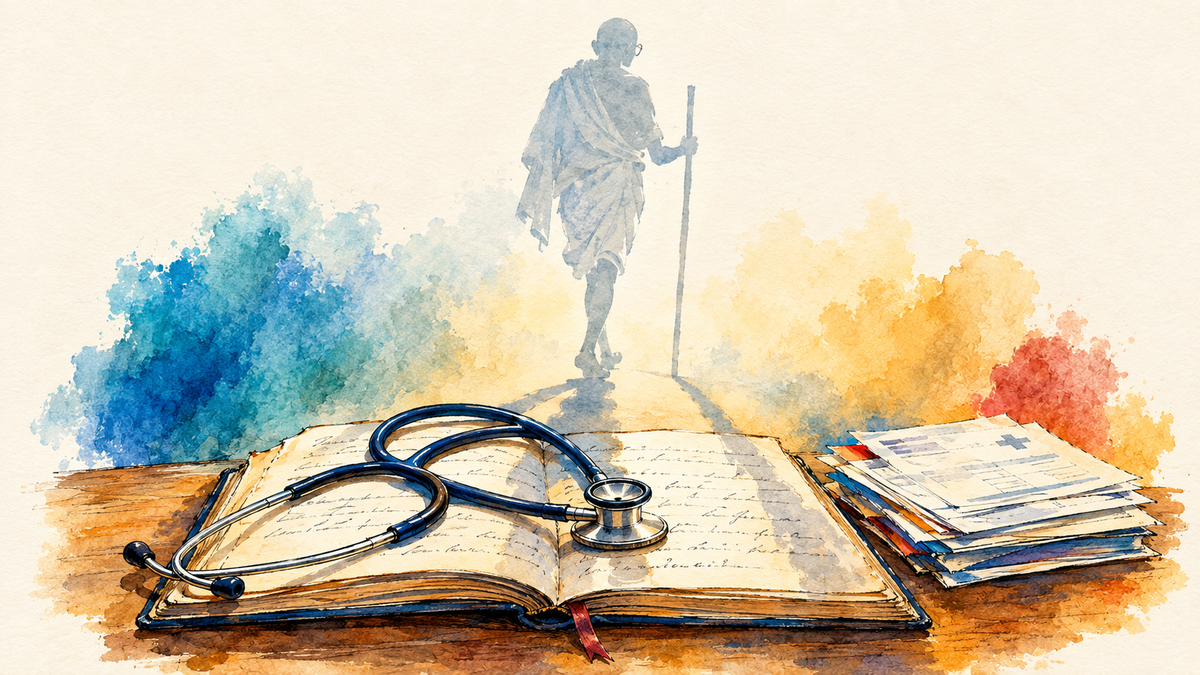
"Doctors make a show of their knowledge, and charge exorbitant fees."
— M. K. Gandhi, Hind Swaraj, Chapter XII
Gandhiji on Doctors: What Hind Swaraj Said a Century Before Bolam
More than a hundred years ago, aboard a steamer between London and South Africa, a young barrister named Mohandas Karamchand Gandhi put down his views on the two professions he knew best: the lawyers and the doctors. He did not flatter either. His chapter on doctors was written nearly fifty years before the English courts gave us the Bolam Test, the yardstick on which cases of medical negligence are still decided today.
We continue to follow Bolam faithfully. We remain reluctant to follow what Gandhiji said a century back, although it is equally true today. This book inspired me to write these blogs for the large number of ideal, honest and ethical doctors, as well as for the victims of medical negligence, advocates, law students and the judiciary. Below, Gandhiji's chapter is reproduced exactly as he wrote it. His words cannot be changed. Our views on them may vary.
Key Takeaways
- Hind Swaraj was written in Gujarati by Gandhiji during a sea voyage from London to South Africa, serialised in Indian Opinion, and later translated by him into English (published 1910).
- The book was seized in India. Gandhiji himself described it as having had a "chequered career".
- Chapter XII, The Condition of India – Doctors, criticises the medical profession for encouraging indulgence, commercialising care, and making a show of knowledge while charging exorbitant fees.
- These views were recorded roughly half a century before Bolam v Friern Hospital Management Committee (1957), the test Indian courts still apply to judge medical negligence.
- The chapter's central charge — that medicine is taken up for honours and riches rather than service — remains uncomfortably relevant.
A Book Written on the High Seas
Mr. M. K. Gandhi wrote Hind Swaraj in Gujarati during his journey by steamer from London to South Africa. It was first published in the weekly Indian Opinion in South Africa. Thereafter, he translated it into English himself, and that version was also published in South Africa in 1910.
The book is written as a dialogue between a "Reader" and an "Editor". The Reader asks the questions an ordinary, educated Indian of the day might ask; the Editor — Gandhiji — answers them. Having dealt with the lawyers in the preceding chapter, he turns his attention to the doctors.
A Book the Empire Seized
Hind Swaraj was seized in India. In Gandhiji's own words, the book had a "chequered career", and he confessed: "I do not know why Hind Swaraj has been seized in India."
A slim book of dialogue, written by a lawyer on a ship, was considered dangerous enough to be banned. That alone tells us how sharply it cut.
Gandhiji and Bolam: Fifty Years Apart
In Bolam v Friern Hospital Management Committee [1957] 1 WLR 582; (1957) 2 All ER 118, the English court held that a doctor is not negligent if he has acted in accordance with a practice accepted as proper by a responsible body of medical men skilled in that particular art. In plain words: a doctor is judged by the standard of other doctors.
Indian courts adopted this test, and the Supreme Court reaffirmed it in Jacob Mathew v State of Punjab (2005) 6 SCC 1. Even in England, Bolitho v City and Hackney Health Authority [1998] AC 232 later cautioned that the professional opinion relied upon must withstand logical analysis. Yet the basic principle — the profession sets the standard by which the profession is judged — still holds the field.
Gandhiji, half a century earlier, was asking a different question altogether. Not "did the doctor follow accepted practice?" but "why did he become a doctor in the first place, and whom does he really serve?" Bolam measures skill. Gandhiji measured motive.
The Text: Chapter XII
Here is Chapter XII, The Condition of India – Doctors, from this historic book written by the Father of our Nation, reproduced as it is.
THE CONDITION OF INDIA – DOCTORS
Reader: I now understand the lawyers; the good they may have done is accidental. I feel that profession is certainly hateful. You, however, drag in the doctors also, How is that?
Editor: The views I submit to you are those I have adopted. They are not original. Western writers have used stronger terms regarding both lawyers and doctors. One writer has likened the whole modern system to the Upas tree. Its branches are represented by parasitical professions, including those of law and medicine, and over the trunk has been raised the axe of true religion. Immorality is the root of the tree. So you will see that the views do not come right out of my mind but represent the combined experiences of many. I was at one time a great lover of the medical profession. It was my intention to become a doctor for the sake of the country. I no longer hold that opinion. I now understand why medicine men (the vaids) among us have not occupied a very honourable status.
The English have certainly effectively used the medical profession for holding us. English physician are known to have used their profession with several Asiatric potentates for political gain.
Doctors have almost unhinged us. Sometimes I think that quacks are better than highly qualified doctors. Let us consider: the business of a doctor is to take care of the body, or, properly speaking, not even that. Their business is really to rid the body of disease that may afflict it. How do these diseases arise? Surely by our negligence or indulgence. I overeat, I have indigestion, I go to a doctor, he gives me medicine, I am cured. I overeat again, I take his pills again. Had I not taken the pills in the first instance, I would have suffered the punishment deserved by me and I would not have overeaten again. The doctor intervened and helped me to indulge myself. My body thereby certainly felt more at ease; but my mind become weakened. A continuance of a course of medicine must, therefore, result in loss of control over the mind. I have indulge in vice, I contract a disease, a doctor cure me, the odds are that I shall repeat the vice. Had the doctor not intervened, nature would have done its work, and I would ave acquired mastery over myself, would have been freed from vice and would become happy.
Hospitals are institutions for propagating sin. Men take less care of their bodies and immorality increases. European doctors are the worst of all. For the sake of a mistaken care of human body, they kill annually thousands of animals. They practice vivisection. No religion sanctions this. All say that it is not necessary to take so many lives for the sake of bodies.
The doctors violate our religious instinct. Most of their medical preparations contain either animal fat or spirituous liquors; both of these are tabooed by Hindus and Mahomedans. We may pretend to be civilized, call religious prohibitions a superstitions and want only to indulge in what we like. The fact remains that the doctors induce us to indulge, and the result is that we have become deprived of self-control and have become effeminate. In these circumstances, we are unfit to serve the country. To study European medicine is to deepen our slavery.
It is worth considering why we take up the profession of medicine. It is certainly not taken up for purpose of serving humanity. We become doctors so that we may obtain honours and riches. I have endeavoured to show that there is no real service of humanity in the profession, and that is injurious to mankind. Doctors make a show of their knowledge, and charge exorbitant fees. Their preparations, which are intrinsically worth a few pence, cost shillings. The populace, in its credulity and in the hope of ridding itself of some disease, allows itself to be cheated. Are not quacks then, whom we know, better than the doctors who put on an air of humaneness?
Reading Gandhiji Today
One need not agree with every line to see the force of the whole. Medicine has changed beyond recognition since 1909. Many of the lives saved today would have been lost in Gandhiji's time, and no sensible reader would throw away modern surgery or antibiotics on the strength of this chapter. On vivisection, on religion, on "European medicine", our views may well differ from his.
But strip away the details of his era and look at the charge itself. Gandhiji says medicine is taken up for honours and riches, not for service. He says doctors make a show of their knowledge and charge exorbitant fees. He says a preparation worth a few pence is sold for shillings, and that a credulous public, desperate to be rid of disease, allows itself to be cheated.
Replace pence with rupees and shillings with thousands, and the paragraph could be a complaint filed before any Consumer Commission in India today. Unnecessary investigations, unnecessary procedures, inflated bills, and a patient too frightened and too ignorant to question any of it — these are not the concerns of 1909 alone.
This is also where Bolam falls short. A doctor may order a battery of tests that no patient needed, and a responsible body of his colleagues, following the same commercial practice, may well say he acted properly. Bolam asks whether he did what other doctors do. Gandhiji would ask why other doctors do it.
None of this is an attack on the honest, ideal and ethical doctor — and there are many. It is precisely for them that these words matter. The ethical doctor loses nothing by Gandhiji's test. It is only the doctor who "puts on an air of humaneness" who has reason to fear it.
Conclusion
Gandhiji wrote this chapter on a ship more than a century ago. The Empire seized his book. The courts gave us Bolam. The profession grew richer, better equipped and more respected. And yet, reading Chapter XII today, one is struck not by how much has changed but by how little.
Nothing has changed till date, except that the "Black & White" movie is now running "Housefull" all over India — in "Eastman Color"!
About the Author
Dr. Mahendra K. Joshi, M.S. (General Surgery), LL.M. (Criminology), M.A.S.L.M.E. (USA)
Ex. Member, State Consumer Commission — Gujarat
[email protected] | +91 98790 94226