Violence Against Doctors: Why India Needs a Doctors Protection Act
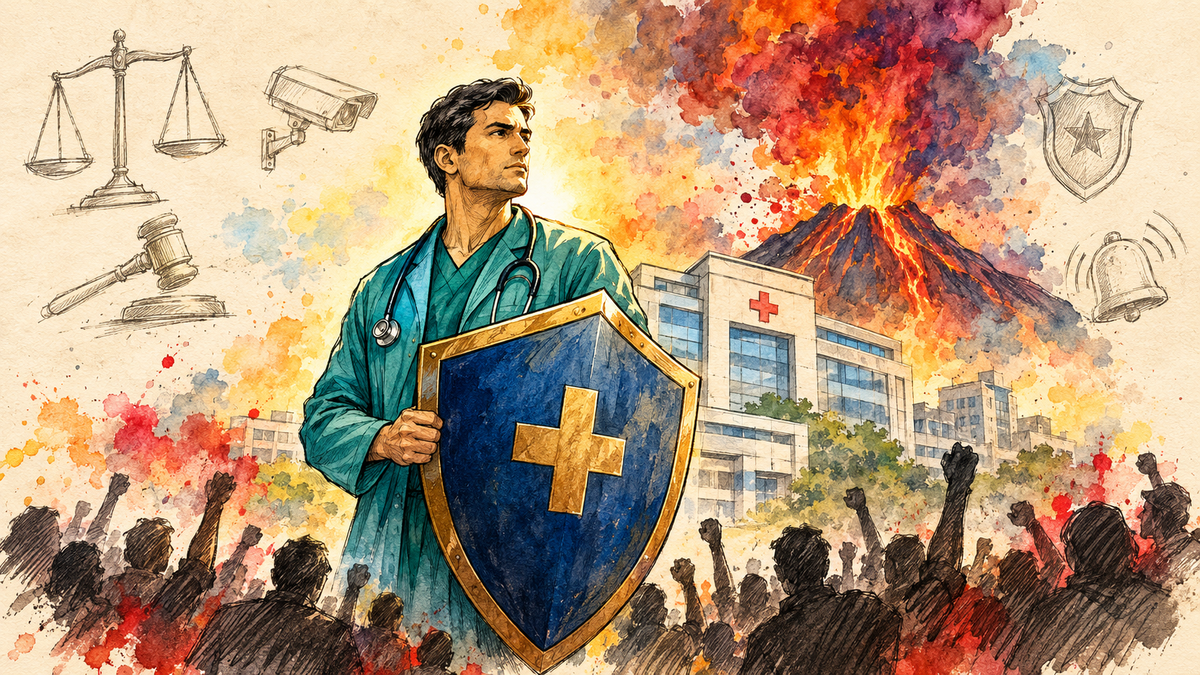
"His professional reputation is as dear to him as his body, perhaps more so, and an action for negligence can wound his reputation as severely as a dagger can his body."
— Lord Denning, Hatcher v Black (1954) Times, 2 July
Violence Against Doctors: Why India Needs a Doctors Protection Act
Recent violent mob attacks on doctors and hospital staff are in no way pardonable. They should be condemned by the whole of society, because they are not in the public interest at large. The Supreme Court criticised such attacks in strong words in the RG Kar case and issued guidelines in 2024. News channels and NGOs have also come forward to raise their voices against these brutal attacks. The Government must take immediate action and punish the culprits heavily, to set an example. The punishment should also be made viral on social and other media, so that a deterrent effect is created in general.
Violence, importantly, is not limited to physical assault. Doctors report verbal abuse, threats, intimidation, vandalism, blackmail and cyber-bullying. The IMA reported in 2025 that about 75% of the doctors surveyed had experienced verbal or physical abuse on hospital premises, and that the fear of violence was a major source of stress. A doctor who must look over his shoulder while treating a critically ill patient is not free to treat him properly, and it is the patient who pays in the end. That is why the country needs a Doctors Protection Act.
Key Takeaways
- Violence against doctors is never justified, and it harms patients and society as much as it harms doctors.
- Medicine is uncertain, and a doctor gets no second chance. It is unjust to make him liable for everything that goes wrong.
- A violent attack is never pre-planned. It is a volcanic blast that follows a long underground rumbling of root causes and then a trigger.
- The root causes are misrepresentation by hospitals, poor communication and unfair criticism by another doctor.
- The triggers are last-minute drama, rude and inhuman behaviour, sudden shifting of the patient, inflated bills with poor care, and a weak police response.
- The corporate hospital has killed the personal touch. The doctor-patient relationship has reached zero level, and that is the main reason for the dissatisfaction.
- A "Doctors Protection Act" on the lines of the Consumer Protection Act should make such violence a cognizable, non-bailable offence, investigated by a senior officer and tried in a fast-track court.
- A law without implementation is only symbolic. It is the fear of certain punishment that makes the attacker cautious.
The Noblest Profession, and the Most Vulnerable
The medical profession is the most noble, but it is also a complicated science. It deals with a human being, a live and precious thing on earth. It is unpredictable and uncertain, and it varies from person to person, drug to drug, dose to dose and procedure to procedure. All systems of medicine are imperfect. Research and experiment bring new techniques, and it is difficult for any doctor to be aware of every piece of research. A drug or procedure well accepted today may be outdated tomorrow.
The doctor also works in emergencies, almost twenty-four hours a day and seven days a week. He faces serious disease, the patient's agony and the relatives' apprehension, which lead to heavy mental stress, with limitations of equipment, staff and his own capacity. Medicine is a one-man show, because the patient wants treatment from one particular doctor only. The doctor must take an immediate decision, and once something is done it cannot be undone, as it may be in other professions. In other words, the doctor does not have a second chance. There may be an error of judgment, a genuine mistake or a misfortune. It is therefore unjust to make a doctor liable for everything that goes wrong.
Lord Denning observed long back in Hatcher v Black (1954) Times, 2 July: "You must not, therefore, find him negligent simply because something happens to go wrong, if, for instance, one of the risks inherent in an operation actually takes away the benefits that were hoped for, or if in a matter of opinion, he makes an error of judgment."
The Supreme Court said the same in Jacob Mathew v. State of Punjab (2005) 6 SCC 1:
"30. If the hands be trembling with the dangling fear of facing a criminal prosecution in the event of failure for whatever reason whether attributable to himself or not, neither a surgeon can successfully wield his life-saving scalper to perform an essential surgery, nor can a physician successfully administer the life-saving dose of medicine. Discretion being better part of valour, a medical professional would feel better advised to leave a terminal patient to his own fate in the case of emergency where the chance of success may be 10% (or so), rather than taking the risk of making a last-ditch effort towards saving the subject and facing a criminal prosecution if his effort fails. Such timidity forced upon a doctor would be a disservice to the society."
If the fear of prosecution can make a surgeon's hands tremble, imagine what the fear of a mob will do.
The Other Side of the Coin: Personal Touch Lost
That was one side of the coin. It is also a hard fact that a decade ago an attack on a doctor or hospital staff was unheard of. At that time there were small nursing homes and maternity homes, and the individual doctor was the owner, with a personal touch. Nowadays there are big multi-specialty hospitals, and the owners are businessmen, with no personal touch at all. In simple words, the doctor-patient relationship has reached zero level. That is the main reason for the dissatisfaction, and for the bursting of the volcano.
The good old days, when it was rare for doctors to be sued for social reasons and because it was difficult to take a case to court, have passed. The era has changed because of increased public awareness. What has happened is unlikely to have been caused by any deterioration in the standard of proof. An authentic survey in the U.K. reported that many litigations could have been avoided had the patients been handled sympathetically by the doctors concerned once an adverse event occurred. In the early stage, patients or their relatives often do not want to create a show. They just wish to receive an explanation of what has happened, together with an expression of sympathy and regret as appropriate. It is the mishandling of the complaint by the doctor or hospital that forces the patient to go for the last avenue open. The report shows that this is mainly because of poor communication between doctor and patient, and because doctors lack training in it.
When a person falls sick he goes to a doctor or hospital with the hope that he will get good treatment and be cured. Patients rely on doctors more than on themselves. They follow every word of a doctor without question, because the doctor belongs to a noble profession. The survival of doctors depends upon patients, and they know that if they work honestly and carefully, success and wealth are bound to follow.
The problem starts only when doctors either practise malpractice to earn money or commit a blunder in this noble field. On admission, every doctor tries to give the best possible treatment, as his reputation is at stake, and every patient just wants relief and a cure. None of them wishes that something should go wrong and that violence should follow.
What the Family Really Wants
It must be understood that it is not the unpredicted event that shocks the family. It is the post-event manner, the behaviour of the doctors and hospital staff, that creates the earthquake. The family just wants:
- To be informed, in a timely manner, of any untoward event which might have contributed to the deterioration or death of the patient, their family member or loved one.
- To be given the opportunity to be actively involved throughout the investigative and regulatory processes.
- To be supported, treated with respect and given honest explanations at all times, by every body with a role in investigation and regulatory action, when things have gone wrong.
Any reasonable family whose member has died due to negligence would naturally think of punishing the doctor. But the violent attack is never pre-planned. It is like a volcanic blast, and the underground rumbling has been going on from the beginning, that is, from admission and the start of treatment. Then something triggers the volcano. The factors can be broadly divided into two parts: root causes and triggering causes.
Root Causes: The Underground Rumbling
1. Misrepresentation
Almost always the attending doctor (qualified or not?) says that the patient is critical, but at the same time draws a rosy picture of himself and of the facilities available in the hospital. He conveys as if he were the best doctor in the world and only this hospital could save the patient. Often in such hospitals every person hanging a stethoscope around his neck is not a qualified allopathic doctor, and every person wearing an apron is not a qualified nurse or technician. These are the "safe hands" to whom the patient's care is entrusted. This is a factor in almost 35% of cases.
2. Poor Communication
More the time you spend with the patient, less the time you will have to spend with the lawyers.
Just two decades ago doctors were respected like God. In a small town or city they were like a family member and advisor. They were invited, not attacked. As Plato said, wise men speak because they have something to say, and fools because they have to say something.
A lack of communication between doctors and patients is often said to be at the heart of many medical negligence allegations. After an unexpected medical accident the doctor or hospital refuses to discuss the circumstances frankly, or refuses to give the medical record, and the doctor-patient relationship breaks down. Many accidents go unnoticed and uneventful. In such a situation the only way open to the patient or relatives to find out what happened is to resort to a violent attack. The doctor must therefore inform the patient about the diagnosis and the proposed treatment. Even at the time of referral, all the details about the patient must be communicated to the doctor to whom the patient is referred. Failure to communicate investigation reports and day-to-day progress personally is also a big factor. This is present in about 75% of cases.
3. Criticism by Another Doctor
There is always a woman behind every successful man. Similarly, there is almost always a critic behind every provocation. When the patient's condition is deteriorating and the treating team is not responding, the family naturally goes for a second opinion. What they get is severe criticism of the treatment. There is a great difference between criticism and a difference of opinion. This is present in about 35% of cases.
Triggering Causes: When the Volcano Blasts
Any unexpected, unexplained and sudden change in the condition, or the death, of the patient is shocking for the family members. These victims are furious, with dry eyes, feeling helpless. The following factors lead to the blasting of the volcano.
1. Last-Minute Drama
In case of death the staff run here and there. Two or three IV bottles, costly injections, may be a blood transfusion, a ventilator, shifting to the ICU, open cardiac massage and so on follow, but not a word is told to the waiting relatives.
2. Rude and Inhuman Behaviour
This is the commonest reason, and it is like adding petrol to fire. A treating doctor who does not talk and evasive replies from the staff on duty are more than enough. Worldwide statistics show that about 40% of complaints about medical negligence are led by this kind of behaviour, and most of the time the attack is just to teach them a lesson.
3. Shifting to Another Hospital
On admission the patient is informed that the hospital has full facilities and a competent staff. When the condition deteriorates, the patient is suddenly shifted to another hospital under the guise of better treatment, without taking the family members into confidence.
4. Inflated Bill and Poor Care
This makes soft and mild human relatives wild like animals. It is argued that if you go to a five-star hotel for a cup of tea you have to spend Rs. 100, and if you go to a dhaba it costs you Rs. 5. But you cannot charge like a five-star hotel and provide service like a dhaba.
5. Poor Response from the Police
No FIR, no arrest and an unsatisfactory response from the police is an important factor. When the police look the other way, the mob learns that it can attack with impunity.
Nobody Has the Right to Take the Law into His Hands
Be that as it may, nobody has the right to take the law into his hands, whosoever he may be. Doctors cannot be expected to work under the threat of physical assault, intimidation, vandalism or political pressure. The hospital must be a place where a doctor can treat a critically ill patient without fearing that an adverse outcome will result in violence.
There are central and state laws for the protection of healthcare people and hospitals, but a law without implementation is largely symbolic. The law should be stricter and implemented properly, so that there is a deterrent effect. The requirement of the 21st century is "Facts, Fears and the Future". It is not the punishment alone but the fear of punishment that will certainly make the violent attacker cautious.
The Doctors Protection Act: What It Should Contain
There should be a "Doctors Protection Act", like the Consumer Protection Act, which should be balanced and in the interest of society at large.
An Act to protect doctors, nurses and other healthcare workers, healthcare establishments and patients from violence, intimidation and obstruction, and for matters connected therewith. It shall extend to the whole of India.
Violence Defined
Violence should include physical attack, verbal threatening and destruction of property causing apprehension.
No Coercion of Clinical Decisions
No person shall compel, threaten or intimidate a healthcare professional to undertake, omit or alter a clinical decision.
Protection Against Persons Holding Public Office or Associated with a Political Party
The offence should be treated as an aggravated offence. There should be no informal political intervention in the investigation, and bail proceedings should specifically consider the accused's ability to influence witnesses or the investigation. This provision has become particularly relevant following the Supreme Court's September 2026 criticism of assaults on doctors by political workers in Maharashtra.
Nature of the Offence and Punishment
The offence should be cognizable, non-bailable and triable by a Magistrate designated under the Act, in a fast-track court. The punishment should be severe, with recovery of damage to hospital property.
Hospitals Must Become Safer Institutions
- Every place where medical service is provided must be registered.
- Details of the staff members, including their qualification and status, must be available online.
- Every staff member should be in uniform and wear a name plate.
The hospitals themselves must become safer institutions. The following facilities should be mandatory for registration.
Protection of Doctors
- CCTV coverage, panic and alarm systems, controlled entry, adequate security and adequate lighting.
- Restricted access to the ICU, OTs, labour room and similar areas.
- Trained personnel responsible for communication with the relatives. Doctors should not be required to conduct difficult conversations alone while simultaneously treating critically ill patients.
Protection of Patients
- A tag on the wrist, informed consent, transparent medical records and access to investigation reports.
- Clear communication regarding complications.
- Limited visitor passes with photograph (a charge may be taken).
From the Emergency Call to the Chargesheet
Call to Police
The police must take an emergency call from a registered hospital on priority and send the required police force immediately. The higher officer must also be informed, and the total response time should be noted in the police station's register.
Reaching the Spot
The police must take the situation under control, calm down the victim's relatives and secure the safety of the doctors, hospital staff and hospital property. Minimum force should be used, and only if required.
Immediate FIR
The SHO must register the FIR immediately.
Investigation
The investigation should be done by a senior police officer not below the rank of DSP. Many IPS officers are now doctors, and it can be proudly mentioned that such qualified IPS officers are easily available in every part of India. An SIT could be formed under such an officer, and the case investigated under his guidance and supervision. It will make both parties satisfied.
- Statements of both the parties, as well as of other patients and their relatives, should be taken.
- CCTV footage should be collected.
- The medical record may be taken into custody.
- A search must be done as in other cases, and the help of forensic experts may be taken.
- Photographs or video recording may be done.
- It should be checked whether the hospital is registered or not.
Arrest
If, after investigation and analysis of the evidence, the SIT arrives at the conclusion that particular persons were involved in the violence, it should arrest them.
Chargesheet
The investigation should ordinarily be completed within 30 days, and the police should file the chargesheet in court.
Trial and Punishment
A Special Prosecutor may be appointed, and the fast-track trial should be completed within six months. The punishment should be severe, with compensation and a heavy fine, so as to have a deterrent effect at large.
Conclusion
This Act is in the interest of the people, because a doctor cannot be expected to work under the threat of violence. The hospital must be a place where a doctor can treat a critically ill patient without fearing that an adverse outcome will result in violence.
It is also desirable that doctors and hospitals introspect and try to avoid the causes, remote as well as triggering, which are really avoidable. Honest representation, timely communication, respectful behaviour, a fair bill and a sympathetic word in the hour of grief cost almost nothing. Remember: more the time you spend with the patient, less the time you will have to spend with the lawyers.
About the Author
Dr. Mahendra K. Joshi, M.S. (General Surgery), LL.M. (Criminology), M.A.S.L.M.E. (USA)
Ex. Member, State Consumer Commission — Gujarat
[email protected] | +91 98790 94226