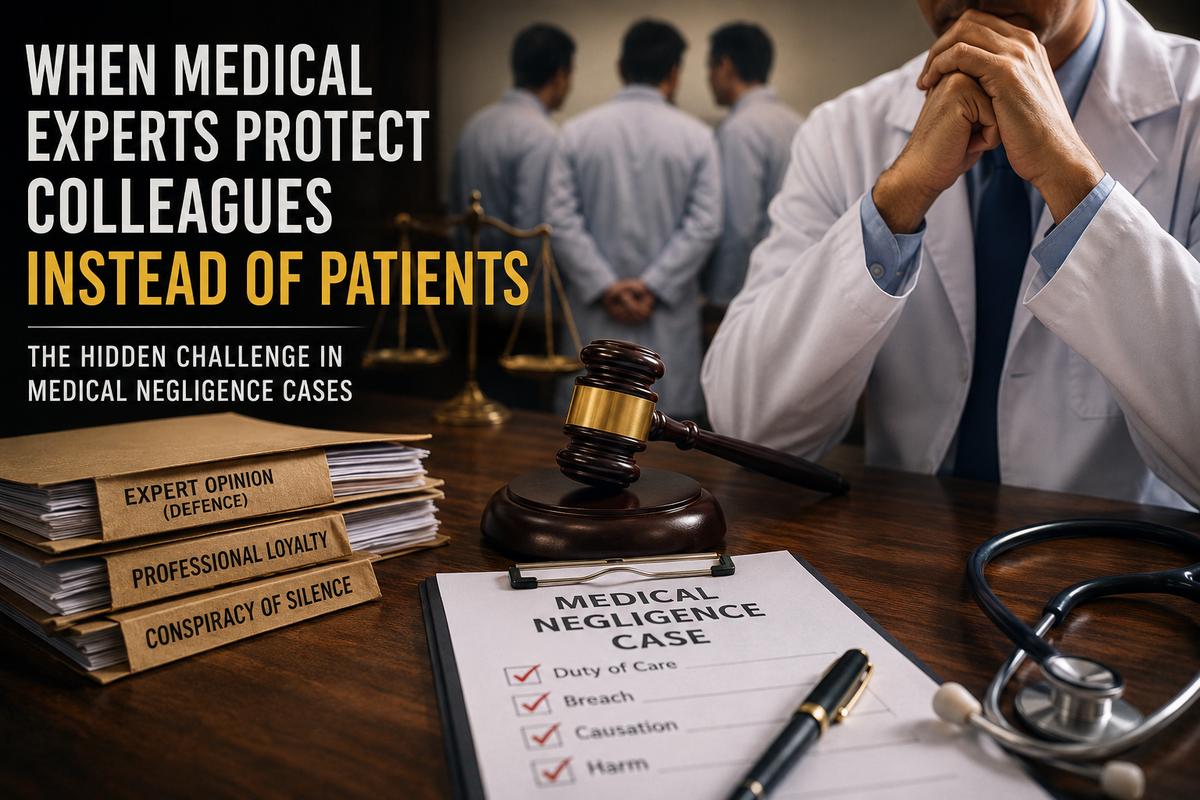
When Medical Experts Protect Colleagues Instead of Patients: The Hidden Challenge in Medical Negligence Cases
"An expert is a man who has made all the mistakes which can be made, in a narrow field."
— Niels Bohr
Medical negligence cases are often won or lost long before a judge examines the evidence. The decisive factor is frequently the opinion of a medical expert.
In principle, specialists assist the judiciary by explaining complex medical issues and clarifying whether the treatment provided met accepted standards of care. In practice, however, obtaining an independent and unbiased professional assessment can be one of the greatest obstacles faced by patients and their families.
The credibility of the justice system depends not only on competent judges and lawyers but also on specialists who are willing to place truth above professional loyalty.
Key Takeaways
- Independent medical assessments are often crucial in negligence claims.
- Patients frequently struggle to find doctors willing to testify against fellow practitioners.
- Courts are not bound by professional opinions and must evaluate their logical foundation.
- A specialist's duty is to assist the administration of justice, not either party to the dispute.
- Unsupported conclusions carry little evidentiary value, regardless of the witness's qualifications.
The Difficulty of Finding Independent Medical Evidence
For many victims, the first challenge is not proving negligence but securing a doctor willing to evaluate another doctor's conduct.
Recognizing this reality, the Supreme Court observed in V. Kishan Rao v. Nikhil Super Speciality Hospital (2010):
"It is known that it is difficult for the complainant to prove a case of medical negligence, especially when doctors are not willing to come forward as experts."
A similar concern was expressed by the National Consumer Disputes Redressal Commission in Dinesh Jaiswal v. Bombay Hospital (2010):
"In Indian conditions, it is very difficult to secure the presence of an expert doctor to file an affidavit against another expert doctor."
These observations reflect a practical reality faced by countless patients across India.
The "Conspiracy of Silence"
One of the most controversial issues in negligence proceedings is the reluctance of medical professionals to criticize colleagues.
Doctors working within the same hospital, city, specialty, or professional network often hesitate to provide evidence against one another. Whether motivated by collegiality, professional courtesy, fear of retaliation, or concern for reputation, the result is often the same: independent opinions become difficult to obtain.
This phenomenon has been described as a "conspiracy of silence."
While most practitioners act ethically, the perception that the profession closes ranks in difficult cases can undermine public confidence in both healthcare and the legal system.
When a Specialist Becomes an Advocate
A medical witness is expected to assist the court, not to strengthen the position of either side.
Unfortunately, some reports appear designed primarily to support a defence rather than provide an objective assessment of the facts. In such circumstances, professional expertise risks becoming advocacy disguised as science.
Warning signs may include:
- Excessive partisanship;
- Overstatement of qualifications or experience;
- Selective reliance on records;
- Conclusions unsupported by data;
- Dismissal of legitimate concerns without adequate explanation; and
- Unwarranted certainty in matters involving clinical judgment.
Credentials alone do not make evidence persuasive. What matters is the reasoning that supports the conclusion.
What Makes a Reliable Medical Witness?
Not every doctor is qualified to evaluate every medical dispute.
Relevant Specialization
The ideal witness should belong to the same field of practice as the practitioner whose conduct is being examined.
For example:
- A surgeon should generally be evaluated by another surgeon.
- An obstetrician should be assessed by an obstetrician.
- A cardiologist should be assessed by a cardiologist.
Specialized knowledge is often essential for understanding the realities of clinical decision-making.
Familiarity with Local Conditions
Standards of care cannot be assessed in isolation from the circumstances in which treatment was provided.
A doctor working in a rural hospital may face limitations in staffing, equipment, laboratory support, blood-bank availability, or diagnostic facilities that are rarely encountered in large metropolitan institutions.
Any professional assessment must take these realities into account.
Independence
Most importantly, the witness must remain impartial.
The duty is owed to the court and the truth—not to the patient, hospital, insurer, or treating doctor.
The True Function of Medical Expertise
No responsible professional can claim absolute certainty.
Every opinion depends upon:
- The available records;
- The accuracy of the facts presented;
- The questions being asked; and
- The state of medical knowledge at the relevant time.
The role of a specialist is to interpret clinical facts through the lens of professional knowledge and experience.
Such witnesses may explain:
- Accepted standards of practice;
- Diagnostic and treatment choices;
- Risks associated with particular procedures;
- Alternative courses of action; and
- Whether a particular outcome was foreseeable.
However, they should not attempt to determine legal liability. Questions concerning negligence, responsibility, or breach of duty ultimately fall within the domain of the judiciary.
Opinion Without Reasons Is Not Evidence
The value of a professional assessment lies not in the conclusion but in the reasoning behind it.
A bare assertion—however confidently expressed—cannot substitute for evidence.
A persuasive report should identify:
- Relevant medical literature;
- Clinical records relied upon;
- Scientific or technical data;
- Established standards of practice; and
- The reasoning process leading to the conclusion.
Where no supporting material is provided, the opinion may offer little assistance in resolving the dispute.
As courts have repeatedly emphasized, expertise does not eliminate the need for logical analysis.
Judges Decide Cases—Not Doctors
An important principle is often overlooked: specialists do not decide negligence claims.
Their role is to provide information and analysis. The final determination belongs to the judge.
The adjudicating authority must examine:
- The medical records;
- Witness testimony;
- Documentary evidence;
- Applicable legal principles; and
- Professional assessments presented by both sides.
When competing opinions are offered, the judiciary is not required to accept either view unquestioningly. The more convincing and logically supported analysis should prevail.
The Importance of Logical Scrutiny
Modern negligence law does not require blind acceptance of professional opinion.
Before relying upon a body of medical thought, the court must be satisfied that it has a rational basis.
Particularly in cases involving difficult choices between competing risks and benefits, specialists should demonstrate that they have carefully considered:
- Available treatment options;
- Potential complications;
- Anticipated benefits;
- The patient's condition; and
- The circumstances confronting the treating doctor at the time.
If a professional opinion cannot withstand logical scrutiny, it may be rejected regardless of how many practitioners support it.
Respectability alone is not enough. Reasoning matters.
The Need for Reform
Improving the quality and independence of medical evidence remains a pressing challenge.
Possible reforms include:
- District-level expert panels;
- State-level independent review boards;
- Transparent appointment procedures;
- Protection for doctors who provide impartial opinions; and
- Mechanisms designed to reduce conflicts of interest.
Such measures could strengthen confidence in both healthcare institutions and the justice delivery system.
Conclusion
Independent medical evidence occupies a central place in negligence litigation. Yet the value of professional expertise lies not merely in qualifications, experience, or reputation.
Its true worth lies in impartiality, intellectual honesty, and the willingness to follow facts wherever they lead.
Judges must remain vigilant to ensure that specialists assist the search for truth rather than determine the outcome themselves. The administration of justice demands nothing less.
As Nicholas Murray Butler famously observed:
"An expert is one who knows more and more about less and less."
The challenge for the legal system is to ensure that such knowledge illuminates the path to justice rather than obscures it.
About the Author
Dr. Mahendra K. Joshi
M.S. (General Surgery), LL.M. (Criminology), M.A.S.L.M.E. (USA)
Former Member, Gujarat State Consumer Disputes Redressal Commission
Email: [email protected]