Are Doctors Above the Criminal Law? Wrongful Death in the Hospital
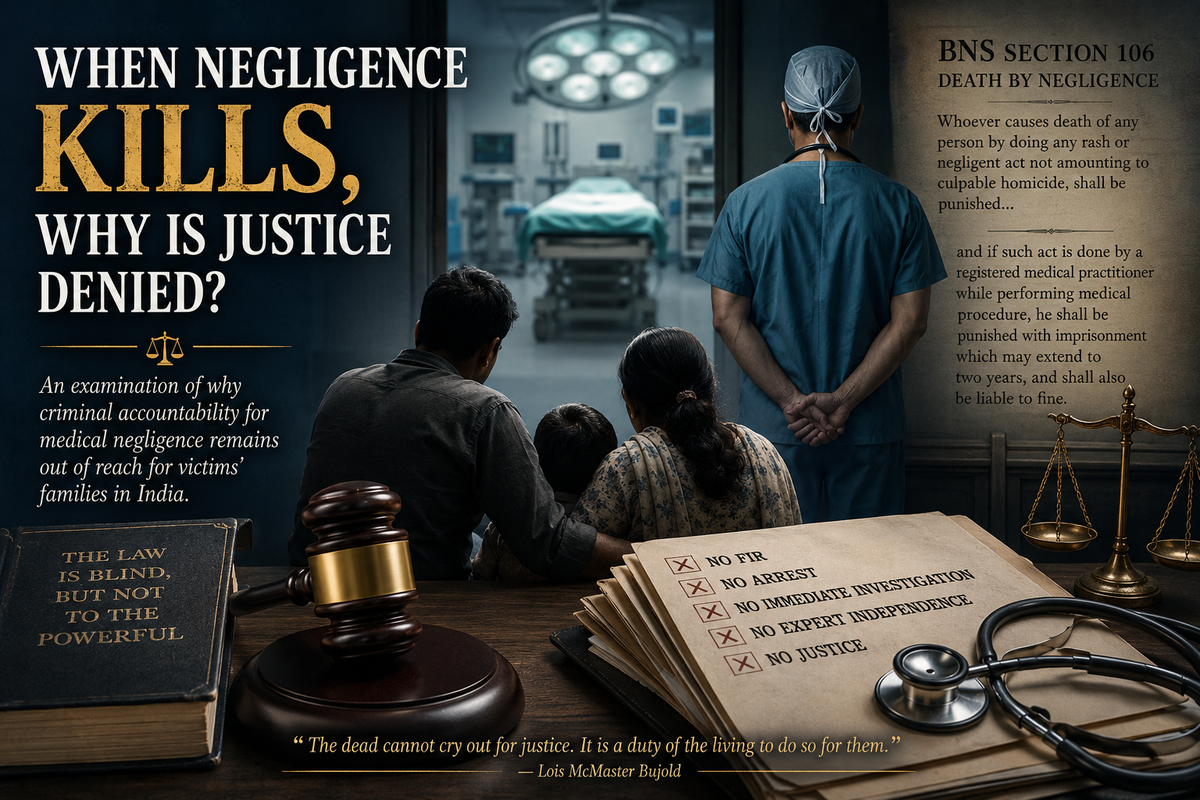
An examination of why criminal accountability for medical negligence remains out of reach for victims' families in India.
1. What is wrongful death?
Wrongful death occurs when a person dies due to another's negligence or intentional act. It may result from a vehicular accident, medical malpractice, or numerous other causes.
In the hospital setting, however, wrongful death carries a unique feature: the patient is typically confined within the four walls of an operation theatre, labour room, cath-lab, or ICU — places where relatives have no access. The doctor is the only person who truly knows what happened and what led to the patient's death. The onus, therefore, should lie on the doctor to explain.
2. Two irreconcilable perspectives
For the doctor, the death may be an "error", a "mistake", an "accident", or a "known complication" — but never negligence.
For the family, any unexpected, unexplained, and sudden death of their loved one is nothing short of murder. Put yourself in the position of the victim's family.
"You people are cutting people's bodies; this is like murder but with good intention. If the consequence is good, it's called surgery; if the consequence is bad, it's called murder, isn't it? Same knife."
— Shri Sadhguru
The family may believe so, but in law, such unnatural deaths are presently covered under Section 106 of the Bharatiya Nyaya Sanhita (BNS), which simply states that whoever causes the death of a person by doing any rash or negligent act shall be punished — and it specifically covers doctors.
3. The driver and the doctor: an instructive comparison
3.1 The driver
Section 106 is usually applied to drivers. Yet a driver is not a mechanic; he may know nothing about the design of the engine or how it functions. Moreover, when a driver kills, he kills a stranger — and the vehicle may or may not even be damaged.
3.2 The doctor
The doctor, by contrast, is both driver and mechanic. He is expected to know the anatomy as well as the physiology and pathology of the "vehicle" — the patient. Here, the death is of a person who, with complete faith in the doctor, placed his life in the doctor's hands — a person the doctor knew intimately. Here, the vehicle (the patient) is completely destroyed. And yet, the doctor is excused.
3.3 The legislative intent
It is significant that the earlier provision — Section 304A of the Indian Penal Code — did not specifically mention doctors. The 21st-century Parliament chose to name them expressly in BNS Section 106. The clear intention of the lawmakers was that doctors should be covered and treated on the same footing as drivers and everyone else.
4. Death by driver: how the law actually works
Imagine a driver causing an accident and killing someone on the road. Would the public — or the police — accept that it was merely an "error" or a "mistake"?
A car driver is prima facie guilty of negligence if the car was speeding or left the road and killed a person, unless the driver offers a plausible explanation. Since it is a cognisable offence, the police act immediately as per law: FIR, arrest of the driver, and investigation — all without waiting for the opinion of "automobile engineers".
5. Death by doctor: how the law works for the privileged
"The dead cannot cry out for justice. It is a duty of the living to do so for them."
— Lois McMaster Bujold
5.1 The police complaint
When a family approaches the police after a suspicious hospital death, the reality is starkly different:
- The police officer will not register an FIR. (Lalita Kumari v. Govt. of U.P., AIR 2014 SC 187)
- He will not arrest the accused doctor.
- He will not even care to seal the place of death for forensic examination.
- He will mostly not take immediate statements of the treating team and other witnesses.
- He will send the body for post-mortem.
- He will send all papers to an expert committee for opinion. (Dr. Jacob Mathew v. State of Punjab, III (2005) CPJ 9 (SC))
- If the report says "no negligence", he will close the case.
5.2 The private complaint in court
Even a private complaint before a magistrate may not be entertained unless the complainant produces the opinion of another competent doctor of the same speciality supporting the charge of rashness or negligence against the accused doctor.
6. The victim's dilemma
Two questions haunt every bereaved family:
- The Jacob Mathew guidelines were meant to be temporary. Doctors today enjoy the protection of various guidelines issued by the Hon'ble Supreme Court, the most important being Jacob Mathew (2005). But those guidelines were expressly interim in nature. The Court never observed that doctors are above the law, and never intended to make doctors totally immune from criminal complaint.
- What about the family's fundamental rights — to health, equality, and justice — under Articles 21, 14, and 39A of the Constitution?
7. Sixteen years of inaction — and unsatisfactory guidelines
After a span of sixteen years (2005 to 2021), an NGO finally sent a legal notice to the National Medical Commission (NMC) demanding the framing of specific guidelines for criminal negligence and the arrest of doctors, in accordance with the Apex Court's directions issued sixteen years earlier. The organisation (PBT) warned that unless the NMC framed guidelines for charging a doctor under IPC 304A, a contempt of Supreme Court case would be brought against the NMC. In response, the NMC has now recommended guidelines for "criminal negligence" by an errant doctor.
Neither victims nor NGOs are satisfied with these guidelines, for the following reasons:
- The guidelines are not balanced.
- There is no provision for immediate investigation.
- There is no representation of victims on the District or State boards.
- The process is time-consuming — by the time it concludes, evidence may well be destroyed.
- How will these boards apply the Bolam test without a single law expert or medico-legal consultant among their members?
8. The ignored parliamentary warning
A Parliamentary Committee report on the IMC Bill, 2013 had itself highlighted the possibility of a conflict of interest between the inquiry team and the accused doctors. The Committee recommended that cases of medical negligence be inquired into by a committee of experts drawn from various fields and backgrounds — including social activists and patients' representatives.
This report was totally ignored by the NMC.
9. Not a licence to kill — but a loophole nonetheless
It must be noted that the intent of the 21st-century drafters of BNS Section 106 was not to create a "licence to kill" for doctors, in the manner of 007 James Bond. Yet in the present scenario — owing to lack of evidence, and at times to some magical advocacy — one can avail illegitimate benefits of this section.
The victim can safely conclude only this: a committee of doctors, with no knowledge of law, will decide the fate of his complaint of criminal medical negligence against an accused doctor.
10. The statutory provisions
10.1 IPC Section 304A — Causing death by negligence
Whoever causes the death of any person by doing any rash or negligent act not amounting to culpable homicide, shall be punished with imprisonment of either description for a term which may extend to two years, or with fine, or with both.
10.2 BNS Section 106 — Death by negligence
Whoever causes death of any person by doing any rash or negligent act not amounting to culpable homicide, shall be punished with imprisonment of either description for a term which may extend to five years, and shall also be liable to fine; and if such act is done by a registered medical practitioner while performing medical procedure, he shall be punished with imprisonment of either description for a term which may extend to two years, and shall also be liable to fine.
Dr. Mahendra K. Joshi
M.S. (Gen. Surgery), LL.M. (Criminology), M.A.S.L.M.E. (USA)
Ex-Member, State Consumer Commission — Gujarat
[email protected] | +91 98790 94226