Should Doctors Be Excluded from the Consumer Protection Act?
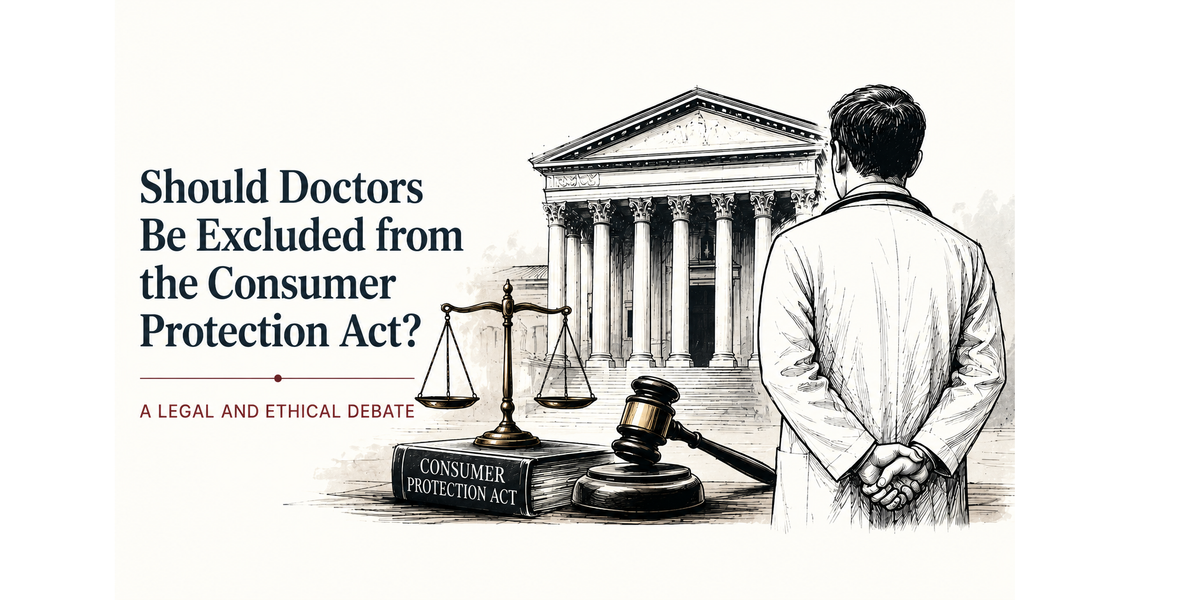
Analysis of the Association of Healthcare Providers (India) Writ Petition and Constitutional Implications
"Once upon a time there was a profession called medicine. Now there is an industry called healthcare. The former was based on direct patient care. The latter rests on control and coordination of the former."
— Richard L. Reece, M.D.
1. Introduction
The Association of Healthcare Providers (India) has recently filed a writ petition seeking the exclusion of medical practitioners from the scope of India's Consumer Protection Act, 1986 (CPA). This petition challenges nearly three decades of established jurisprudence and raises fundamental questions about patient rights, medical accountability, and access to justice. This analysis examines the contentions advanced in support of exclusion and demonstrates why such exclusion would be constitutionally problematic and contrary to the interests of patients across India.
2. Historical background
2.1 The Consumer Protection Act, 1986
The Consumer Protection Act was first enacted in 1986 and became operationally functional in 1990. Prior to this legislation, victims of medical negligence were limited to pursuing civil remedies through lengthy and expensive court proceedings.
2.2 Medical malpractice cases before and after CPA
A telling statistic illustrates the significance of the CPA for medical accountability in India: from Independence in 1947 until 1990, fewer than 20–25 reported cases against doctors were filed in Indian courts. This striking absence of litigation does not indicate the absence of medical negligence; rather, it reflects the prohibitive cost and complexity of pursuing civil remedies.
Following the landmark judgment of the Hon'ble Supreme Court in IMA v. V.P. Santha (1995) 1 SCC 388, which classified medical services as "services" under the CPA, a more accessible avenue for victims emerged. This decision opened the door to affordable, expedited grievance redressal through consumer courts, transforming the landscape of medical accountability in India.
3. The scale of medical negligence in India
Recent data underscores the critical importance of maintaining robust accountability mechanisms in healthcare. The evidence is sobering:
Finding
- Estimated 5.2 million medical malpractice and negligence incidents annually
National Library of Medicine (2022) - Vast majority of incidents go unreported due to cost, complexity, and lack of awareness
Medical negligence research - Approximately 80% of fatalities from medical errors linked to surgical mistakes
Healthcare quality studies - Approximately 70% of emergency room fatalities stem from team mismanagement and poor communication
Healthcare quality studies
These figures demonstrate that medical negligence is not a rarity in India but a systemic challenge affecting millions. Excluding doctors from the CPA would leave this vast population of victims without an adequate remedy.
4. Analysis of contentions advanced for exclusion
4.1 The Bar of Indian Lawyers Precedent Does Not Support Excluding Medical Professionals from the CPA
Contention: The Petitioner relies upon the decision of the Hon’ble Supreme Court in Bar of Indian Lawyers v. D.K. Gandhi, II (2024) CPJ 33 (SC), wherein advocates were held to be outside the ambit of the Consumer Protection Act ("CPA"), and contends that medical professionals ought to receive a similar exclusion.
Rejoinder: The Petitioner’s reliance on Bar of Indian Lawyers is misplaced. The judgment was confined to the unique nature of the legal profession and did not lay down any principle warranting the exclusion of all professions from the CPA.
Significantly, while deciding Bar of Indian Lawyers, a two-judge Bench had referred the question of reconsidering the landmark decision in Indian Medical Association v. V.P. Shantha, (1995) 6 SCC 651, to a larger Bench. However, the Hon’ble Supreme Court, by order dated 7 November 2024, declined to entertain such reconsideration.
A three-judge Bench comprising Hon’ble Justices B.R. Gavai, Prashant Kumar Mishra, and K.V. Viswanathan expressly observed:
"We find that the issue before the Court was with regards to the legal profession and the court, in unequivocal terms, came to a conclusion that the legal profession is not covered by the provisions of the Consumer Protection Act. Since the court came to the aforesaid finding, irrespective of the finding of this court in Shantha, the reference was not necessary. The question as to whether the other professionals excluding legal profession could be covered under the Act can be considered in appropriate cases, having a factual foundation."
The Bench accordingly closed the reference and declined to revisit V.P. Shantha. Thus, the legal position established in Indian Medical Association v. V.P. Shantha continues to hold the field and remains binding law under Article 141 of the Constitution.
Far from supporting the Petitioner’s case, the developments following Bar of Indian Lawyers reaffirm that medical services continue to be governed by the Consumer Protection Act, subject to the principles laid down in V.P. Shantha. The judgment cannot be read as creating a general exemption for all professions, nor can it be invoked to dilute the settled position regarding the accountability of healthcare providers under consumer law.
4.2 Medicine as a profession, not a commercial service
Contention: Medicine, like law, is a noble profession involving complex judgment and clinical uncertainty. It should not be treated as a commercial service subject to consumer protection rules.
Rejoinder: This argument lacks grounding in contemporary reality. Modern medical practice, particularly in India, is increasingly corporatized. Private hospitals, corporate chains, and for-profit diagnostic centers dominate urban healthcare delivery. These entities charge substantial fees, maintain business models, and operate for profit. The notion that healthcare exists in some separate realm beyond commercial considerations is unrealistic.
Moreover, the distinction between "profession" and "service" is irrelevant under the CPA. A service is defined broadly as any act or activity provided in return for consideration. A doctor providing consultation or performing surgery in exchange for a fee is providing a service. Accepting payment does not diminish professional responsibility; rather, it strengthens the patient's legitimate expectation of competent, diligent care. The Supreme Court addressed precisely this issue in IMA v. VP. Santha and correctly determined that medical services fall within the CPA.
4.3 The fiduciary trust argument
Contention: Treating the doctor-patient relationship as a consumer transaction (like a shopkeeper-customer relationship) undermines the trust and confidentiality essential for effective medical care.
Rejoinder: This argument is paradoxical. If anything, it demonstrates why the CPA is necessary. Patients place extraordinary trust in doctors with their lives and the lives of their loved ones. Precisely because this trust is so profound, breaches of that trust demand accountability. The CPA does not diminish the doctor-patient relationship; it protects and vindicates it by providing a forum for victims whose trust has been violated.
The argument also assumes that patient rights and professional ethics are in tension. They are not. A competent, ethical doctor has nothing to fear from patient access to consumer courts. It is the negligent doctor whose interest is served by limiting accountability.
4.4 Defensive medicine
Contention: The threat of consumer litigation induces "defensive medicine"—unnecessary investigations, treatments, and surgical procedures undertaken not for patient benefit but to protect against legal liability.
Rejoinder: If this contention were true, the solution is professional discipline and ethical oversight, not immunity from consumer accountability. Moreover, there is a clear distinction between medically justified precautionary measures and genuinely unnecessary procedures. A surgeon who recommends bypass surgery without appropriate indication, or a cardiologist who prescribes expensive interventions for minor conditions, acts not out of defensive caution but for financial gain.
Public observation in India reflects precisely this concern. The dramatic increase in elective surgeries and invasive interventions, frequently driven by profit motive rather than clinical necessity, has become a subject of legitimate public concern. The CPA provides an essential check on such practices. Defensive medicine, when it occurs, is a small price for accountability.
4.5 The alternative forum argument
Contention: The National Medical Commission (NMC) and state Medical Councils are the appropriate forums for addressing doctor misconduct. Consumer courts, staffed by non-medical personnel, lack the expertise to evaluate complex medical judgments.
Rejoinder: This argument conflates two distinct issues: professional misconduct and negligence.
1. Professional misconduct vs. negligence: The question here is not professional conduct but legal negligence. Negligence is a well-established legal doctrine, not a medical one. Consumer courts are competent to determine whether a doctor fell below the standard of care expected of a reasonable, skilled practitioner in similar circumstances. This is a legal determination, not a medical one, and does not require medical expertise on the bench.
2. Expertise of consumer courts: Consumer courts are staffed by retired judges and experts. They routinely handle complex technical matters ranging from pharmaceutical safety to engineering defects to automotive failures. Medical matters are not inherently more opaque. Expert medical witnesses testifying before consumer courts provide the necessary technical guidance.
3. Conflict of interest in NMC proceedings: A fundamental objection to the NMC as the sole forum is the inherent conflict of interest. The NMC is composed of doctors disciplining doctors. An independent judicial forum, staffed by non-medical professionals applying established legal standards, provides greater impartiality and public confidence.
4. Track record of medical councils: Historically, the Medical Councils have shown reluctance to discipline their own members. From Independence until now, only a few hundred doctors have been punished across all Medical Councils in India—a figure far out of proportion to the 5.2 million annual negligence incidents reported. This demonstrates the inadequacy of professional self-regulation.
5. Lack of compensatory authority: Critically, the NMC and Medical Councils lack authority to award compensation to victims. Their disciplinary role is limited to registration suspension or cancellation. A victim of medical negligence deserves not just punishment of the negligent doctor but financial redress for medical expenses, pain and suffering, and lost wages. Only civil courts and consumer forums can provide this.
5. Constitutional implications
Right to health and access to justice: India's Constitution, read in conjunction with the Universal Declaration of Human Rights and international human rights conventions to which India is a signatory, recognizes the fundamental right to health. This right necessarily includes the right to a remedy when that health is violated through professional negligence.
Access to justice is a cornerstone of constitutional democracy. To exclude medical negligence cases from the affordable, expedited forum of the CPA would effectively deny justice to millions of ordinary Indians who lack the resources to pursue costly civil suits. Such exclusion would violate the constitutional guarantee of equal protection and access to justice.
6. Conclusion
6.1 The unique responsibility of medical practitioners
A surgeon's error is not an abstract professional mistake—it may result in permanent disability or death. A diagnostic error may cost a patient their life. Patients invest incomparable trust in doctors with their lives and the lives of their loved ones. This extraordinary trust brings with it a correspondingly high duty of care and, when breached, a legitimate expectation of accountability.
6.2 The problem before the CPA
Before the CPA became operative in 1990, victims of medical negligence were forced to pursue costly, time-consuming civil suits through the District Courts. The vast majority of injured patients—lacking resources or legal knowledge—suffered in silence, receiving neither accountability nor compensation. The CPA transformed this landscape, providing an accessible, expert, and affordable forum for redressal.
6.3 The question of remedy
If doctors are excluded from the CPA, where shall victims of medical negligence seek redress? Constitutional law and the rule of law demand that every person whose fundamental right to health has been violated must have access to a remedy. If not the consumer courts, then the petitioner must articulate an alternative. The suggestion that medical councils—themselves composed of doctors and historically reluctant to discipline their own—should be the exclusive forum is neither constitutionally sound nor practically adequate.
The writ petition seeking exclusion of doctors from the CPA should be rejected. The CPA, as currently applied, represents the best balance between professional autonomy and patient protection. It preserves the dignity of the medical profession while ensuring accountability and justice for those harmed by medical negligence.
Dr. Mahendra K. Joshi
M.S. (General Surgery), LL.M. (Criminology), M.A.S.L.M.E. (USA)
Former Member, State Consumer Commission, Gujarat
Email: [email protected]
Mobile: +91 98790 94226