Bolam Test Explained: Medical Negligence Law in India
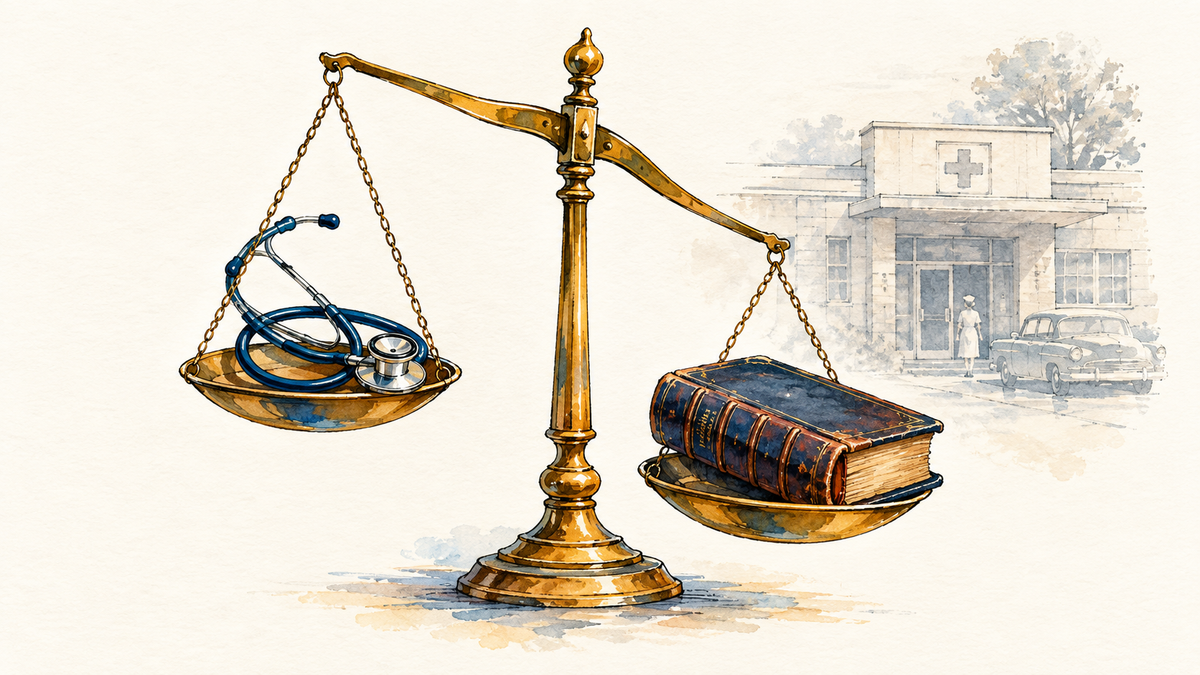
"A doctor is not guilty of negligence if he has acted in accordance with a practice accepted as proper by a responsible body of medical men skilled in that particular art."
— McNair J, Bolam v Friern Hospital Management Committee (1957)
The Bolam Test: The 1957 English Rule That Still Decides Medical Negligence Cases in India
Doctors and hospitals in India have reason to be happy. Our judiciary still faithfully follows the "Bolam Test", popularly understood as "Doctor knows best", and almost every medical negligence case in the country is decided by referring to it. Lawyers quote it, judges cite it, consumer commissions rely on it, and expert boards are asked to apply it.
And yet, interestingly, more than half of the people who refer to this test know nothing about it except its name. They do not know what principle it laid down, nor how it actually applies in a medical negligence case. An Englishman named Mr. Bolam should thank our judiciary from heaven, because a single 1957 ruling bearing his name is still used by Indian courts, nearly seventy years later, to judge whether a doctor was careless. So what exactly is this test, and why does it matter to every patient?
Key Takeaways
- The Bolam Test comes from an English case, Bolam v Friern Hospital Management Committee (1957) 2 All ER 118, about a patient injured during electro-convulsive therapy (ECT).
- In simple words: a doctor is not negligent if he followed a practice that a responsible group of doctors in that field accepts as proper, even if other doctors would have done it differently.
- The famous "test" was originally just the judge's explanation of the law to a jury of ordinary citizens, not a carefully reasoned judicial ruling.
- Bolam answers only one question: did the doctor meet the expected standard of care? It is not a complete test of medical negligence.
- Indian courts apply Bolam in civil cases, in informed consent cases (Samira Kohli), and as a starting point in criminal cases, where the negligence must additionally be "gross" (Jacob Mathew, Martin D'Souza).
- England itself has since moved beyond pure Bolam, while India continues to hold on to it.
The Story Behind the Test
Who Was Mr. Bolam?
Mr. Bolam was a patient suffering from depression. He was admitted to Friern Hospital in England and advised ECT (electro-convulsive therapy), a treatment in which a controlled electric current is passed through the brain to induce a seizure. He agreed.
What happened next became legal history:
- The doctor did not warn him about the small risk of bone fracture, because the normal medical practice of the time was not to mention such small risks.
- The doctor did not give a relaxant drug (a medicine that relaxes the muscles so the body does not jerk violently during the seizure).
- The doctor did not use manual restraint (holding the patient down).
During the treatment, Mr. Bolam's body convulsed violently and he suffered serious injuries, including fractures of both hip sockets (bilateral fracture of the acetabula).
What Did He Complain About?
Mr. Bolam sued the hospital, alleging that the doctors were negligent in:
- Failing to give him a suitable relaxant drug.
- Failing to provide sufficient manual control (restraint) of his body.
- Failing to warn him of the risks involved in ECT.
What Did the Witnesses Say?
- On Mr. Bolam's side: a medical expert testified that some manual restraint was necessary.
- On the hospital's side: several medical experts testified. One said his own hospital had stopped using manual restraint after 1951, and from his clinical experience the risk of fracture had not increased, and might even have decreased.
The overall picture from the experts was clear: different doctors used different methods for ECT. Some used relaxant drugs, some used restraint, and some used neither. There was no single "correct" way.
How the Case Was Decided
The Role of the Jury
In those days, England used juries in such civil cases (known as "tort" cases, meaning civil wrongs for which compensation can be claimed). A jury is a group of ordinary citizens selected to decide the facts. They heard the competing medical evidence and decided whether the hospital had been negligent.
The judge's role was only to explain the law to the jury and leave the final decision to them.
What the Judge Told the Jury
Justice McNair pointed out to the jury that, as the expert witnesses had confirmed, much medical opinion was against the use of relaxant drugs, and manual restraint could sometimes actually increase the risk of fracture. He also noted that it was the common practice of the profession not to warn patients of a small risk unless they asked.
He then explained the law in four broad points:
- Ordinary skill is enough. A doctor need not possess the highest expert skill. It is sufficient if he exercises the ordinary skill of an ordinary competent person practising that particular art.
- Following accepted practice is not negligence. A doctor is not guilty of negligence if he acted in accordance with a practice accepted as proper by a responsible body of medical men skilled in that particular art.
- A difference of opinion does not make a doctor negligent. A doctor following such a practice is not negligent merely because another body of medical opinion takes a contrary view.
- The warning question. If proper practice did require a warning, the next question is: had the warning been given, would it have made any difference? (Would the patient have refused the treatment?)
The jury delivered a verdict in favour of the hospital. Mr. Bolam lost.
A little-known fact: The famous "Bolam principle" was originally a direction given by a judge to a jury of laymen. It was not a detailed judicial test worked out after a judge alone carefully evaluated the medical evidence. Yet this jury direction has become one of the most quoted rules in Indian medical law.
Bolam Is Only One Piece of the Puzzle
Here is what most people miss: Bolam is a standard-of-care test, not a complete medical negligence test. To prove medical negligence, a patient generally has to establish four things, commonly called the "4 Ds of Medical Negligence":
- Duty – The doctor or hospital owed the patient a duty of care. (Once a doctor accepts a patient, this duty arises.)
- Dereliction (breach of duty) – The doctor failed to meet the expected standard of care. This is the only stage where the Bolam Test applies.
- Direct causation – The doctor's failure caused, or materially contributed to, the patient's injury.
- Damage – The patient suffered real, legally recognised harm or loss.
So even if a doctor fails the Bolam Test, the patient must still prove that the failure actually caused the harm. And even if a doctor passes it, a court must still be satisfied on the other three Ds.
How Indian Courts Have Used Bolam
Civil Medical Negligence
Dr. Laxman Balkrishna Joshi v Dr. Trimbak Bapu Godbole, AIR 1969 SC 128
Facts in brief: A 20-year-old boy suffered an accidental fracture of the thigh bone (femur). The doctor reduced the fracture (set the bone back in place) without giving anaesthesia, allegedly using excessive force, and the boy died. The doctor's defence was that an injection of morphine had been given and that the death was due to cerebral embolism (a blockage of blood supply to the brain).
The Trial Court held that the excessive force used without anaesthesia caused shock, which was the real cause of death. The High Court agreed, observing that the doctor's theory of cerebral embolism was merely a cloak to hide the real cause, namely shock.
The Supreme Court laid down the duties every doctor owes to a patient:
- a duty of care in deciding whether to take up the case;
- a duty of care in deciding what treatment to give; and
- a duty of care in actually giving that treatment.
A breach of any of these gives the patient a right to sue for negligence. The Court held that the law requires a reasonable degree of skill, knowledge and care, "neither the very highest nor a very low degree of care and competence", judged in the light of the particular circumstances of each case.
Achutrao Haribhau Khodwa v State of Maharashtra, (1996) 2 SCC 634
The Supreme Court recognised that skill differs from doctor to doctor and that there may be more than one acceptable way of treating a patient. Courts would therefore be slow to blame a doctor who has done his best with due care and caution. If the doctor acted in a manner acceptable to the medical profession, and with due care, skill and diligence, he cannot be held negligent merely because the patient did not survive or was left with a permanent disability.
But the Court also drew the line: where a doctor acts carelessly, in a manner not expected of a medical practitioner, a case for compensation would certainly lie.
Informed Consent
Samira Kohli v Dr. Prabha Manchanda, (2008) 2 SCC 1 : I (2008) CPJ 56 (SC)
How much must a doctor tell a patient before treatment? There are two broad approaches:
- The Bolam approach ("Doctor knows best"): the doctor must disclose what a responsible body of doctors would normally disclose.
- The "reasonably prudent patient" approach from the American case of Canterbury v Spence: the doctor must disclose whatever a reasonable patient would want to know to make a decision.
The Supreme Court clearly preferred the "real consent" concept evolved in Bolam over the Canterbury approach, citing the ground realities of medical and health care in India. In other words, in India the doctor, not the patient, still largely decides how much the patient needs to be told. This is the warning aspect of the Bolam direction (point 4 above) in action.
Criminal Medical Negligence
Civil negligence means paying compensation. Criminal negligence means facing prosecution, and possibly jail. The bar is rightly much higher.
Jacob Mathew v State of Punjab, (2005) 6 SCC 1
The Supreme Court accepted Bolam as the yardstick for medical negligence in India, but on the facts held that the accused doctor could not be proceeded against under Section 304A, IPC (causing death by negligence) on the parameters of Bolam's test alone. For criminal liability, something more is required.
Martin F. D'Souza v Mohd. Ishfaq, (2009) 3 SCC 1 : I (2009) CPJ 32 (SC)
The Court explained the difference plainly:
- For civil liability, it may be enough to prove that the doctor did not exercise reasonable care.
- For criminal liability, it must also be proved that the negligence was gross, amounting to recklessness.
(Note for readers: Section 304A IPC has since been replaced by Section 106(1) of the Bharatiya Nyaya Sanhita, 2023, which contains a specific provision for registered medical practitioners carrying a lesser punishment.)
The NMC Twist
Surprisingly, under the National Medical Commission's guidelines of 29 September 2021, the Medical Boards that examine alleged criminal medical negligence are required to apply the Bolam Test to the facts of the case, a civil standard-of-care test applied to a criminal question.
The million-dollar question is: do all the members of these Expert Boards know anything about the Bolam Test, beyond its name?
Meanwhile, Back in England
It is worth noting that the country that gave us Bolam has itself moved on:
- In Bolitho v City and Hackney Health Authority [1998] AC 232, the House of Lords held that the medical opinion relied upon must be capable of withstanding logical analysis. A court need not accept a body of medical opinion simply because doctors hold it.
- In Montgomery v Lanarkshire Health Board [2015] UKSC 11, the UK Supreme Court discarded Bolam for informed consent altogether, holding that doctors must disclose risks that a reasonable patient would consider significant.
So while England has shifted towards the patient's right to know, Indian law on consent still rests on "Doctor knows best."
Conclusion
The Bolam Test applies to only one of the four Ds: Dereliction, that is, whether the doctor fell below the expected standard of care. In plain words, it says:
- ordinary skill is sufficient;
- following an accepted practice is not negligence;
- another body of doctors holding a different opinion does not make the doctor negligent; and
- a warning need not be given if accepted practice does not require it.
Anyone who quotes Bolam as if it were the whole of medical negligence law, whether a lawyer, a judge, or a member of an expert board, has understood only its name.
It is interesting to note that Lord Denning, in Hatcher v Black (The Times, 2 July 1954), three years before Bolam, had already captured the spirit behind it when he told a jury: "An action for negligence against a doctor is for him like unto a dagger. His professional reputation is as dear to him as his body, perhaps more so, and an action for negligence can wound his reputation as severely as a dagger can his body. You must not, therefore, find him negligent simply because something happens to go wrong... You should only find him guilty of negligence when he falls short of the standard of a reasonably skilful medical man."
About the Author
Dr. Mahendra K. Joshi
M.S. (General Surgery), LL.M. (Criminology), M.A.S.L.M.E. (USA)
Ex. Member, State Consumer Commission — Gujarat
[email protected] | +91 98790 94226