S.304-A of IPC vs S.106 of BNS - Death by Negligence
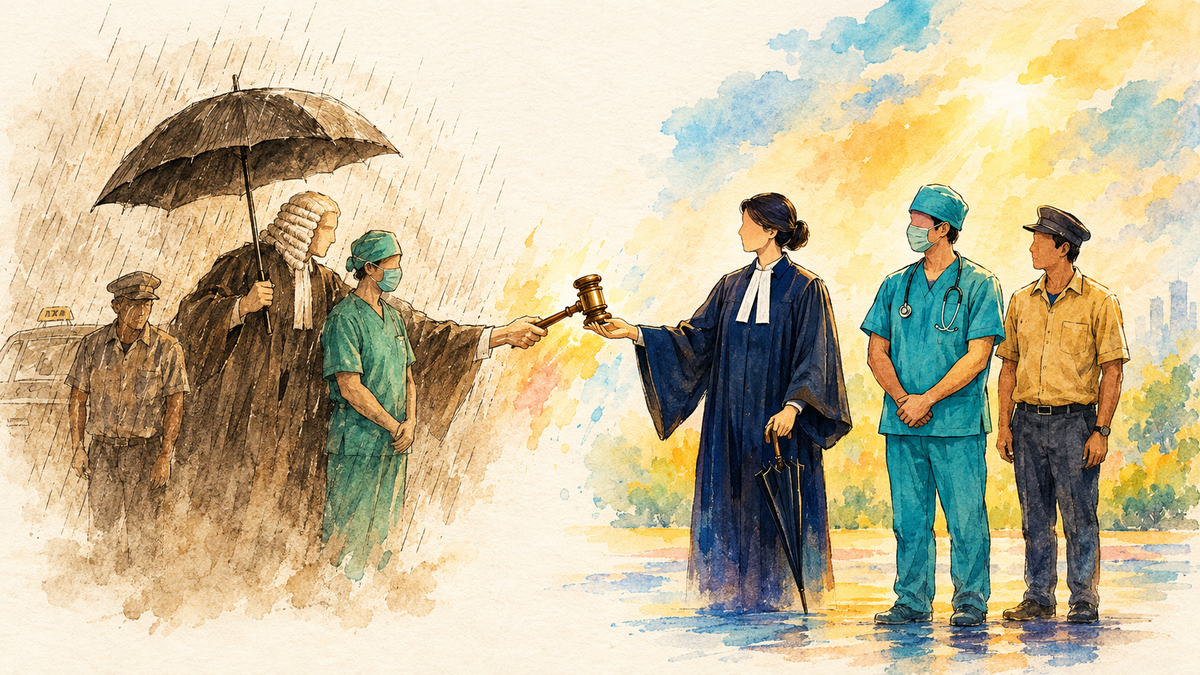
"The law was never meant to hand any profession a lifetime licence to kill."Dr. Mahendra K. Joshi
S.304-A of IPC vs S.106 of BNS - Death by Negligence
For more than six decades, an alleged death of a patient due to the negligence of a doctor was dealt with under Section 304-A of the Indian Penal Code (IPC), Causing death by negligence. Since 1 July 2024, the same ground is covered by Section 106 of the Bharatiya Nyaya Sanhita (BNS), Death by negligence.
Both doctors and the families of patients who died allegedly due to medical negligence are now in a dilemma. What exactly has changed in the new BNS? And is that change in favour of doctors, or in favour of victims? The answer lies not in commentaries but in reading the two sections side by side, word by word.
Key Takeaways
- IPC S.304-A and BNS S.106 use the same core language: a "rash or negligent act not amounting to culpable homicide."
- BNS S.106 raises the general maximum sentence from two years to five years and makes fine mandatory.
- For the first time, a registered medical practitioner is named in the statute itself - doctors are expressly within the section, with a separate maximum of two years plus mandatory fine.
- Parliament did not insert the word "gross" before "negligence," even though the judiciary had read it into S.304-A in Jacob Mathew.
- In Prabhat Kumar Singh v. State of Bihar (2021), the Supreme Court held that medical negligence does not require mens rea in the sense of malicious intent.
- Two questions now stand before the courts: will doctors still be placed on a different footing, and will "gross" still be read into a section that Parliament deliberately left without it?
The Two Sections Side by Side
IPC S.304-A - Causing death by negligence
Whoever causes the death of any person by doing any rash or negligent act not amounting to culpable homicide, shall be punished with imprisonment of either description for a term which may extend to two years, or with fine, or with both.
BNS S.106 - Death by negligence
Whoever causes death of any person by doing any rash or negligent act not amounting to culpable homicide, shall be punished with imprisonment of either description for a term which may extend to five years, and shall also be liable to fine; and if such act is done by a registered medical practitioner while performing medical procedure, he shall be punished with imprisonment of either description for a term which may extend to two years, and shall also be liable to fine.
| Feature | IPC S.304-A | BNS S.106 |
|---|---|---|
| Core offence | Rash or negligent act not amounting to culpable homicide | Same |
| General maximum sentence | 2 years | 5 years |
| Fine | Fine, or imprisonment, or both | Fine is mandatory, in addition to imprisonment |
| Doctors mentioned? | No | Yes - "registered medical practitioner while performing medical procedure" |
| Maximum for doctors | 2 years (same as everyone) | 2 years, plus mandatory fine |
| Word "gross" | Absent (read in by judiciary) | Absent |
Applicability: One Section, Two Standards
It is interesting to note that IPC S.304-A applied equally to vehicle drivers and to doctors. Many drivers were convicted and punished under it - yet it is hard to find a doctor who was ever punished, as if this section had never been written for doctors at all!
The judiciary, in effect, put doctors on a different footing. The real impact fell not on doctors or drivers but on the victims. Families of road-accident victims usually received criminal justice. Families of victims of medical negligence found it almost impossible to obtain criminal justice.
Is the life of a patient on an operation table worth less than the life of a pedestrian on the road?
What Has Been Inserted
The most notable insertion in BNS S.106 is that doctors are now specifically covered:
"...if such act is done by a registered medical practitioner while performing medical procedure, he shall be punished..."
The intent of the 21st-century drafters of BNS S.106 is very clear. Doctors are very much within the section, just like vehicle drivers. A negligent doctor, therefore, is meant to be punished like any other negligent person - not handed a "lifetime licence to kill" like 007 James Bond.
Notice what Parliament did and did not do. It gave doctors a lower maximum sentence (two years, against five for others) - a concession on punishment. It did not give doctors a higher threshold of liability. If Parliament had wanted only "gross" negligence by doctors to be punished, it was writing that very sentence about doctors and could have said so. It chose not to.
The Supreme Court before Jacob Mathew
When the question first came before a two-judge bench of the Hon'ble Supreme Court, the bench expressed serious doubt about the view taken earlier in Dr. Suresh Gupta v. Govt. of NCT of Delhi (2004) 6 SCC 422, which had required a high degree of negligence for a doctor's criminal liability. The bench observed, in substance:
- Negligence or recklessness being "gross" is not a requirement of Section 304-A of IPC. If the view in Dr. Suresh Gupta is followed, the word "gross" would have to be read into Section 304-A for fixing criminal liability on a doctor - an approach that cannot be countenanced.
- Different standards cannot be applied to doctors and others. In all cases, it has to be seen whether the impugned act was rash or negligent. Carving out a separate treatment for doctors by introducing degrees of rashness or negligence would do violence to the plain and unambiguous language of Section 304-A. A doctor cannot be placed on a different pedestal for deciding whether rashness or negligence was involved.
Jacob Mathew v. State of Punjab (2005) 6 SCC 1
The matter was then referred to a larger bench. In Jacob Mathew, the three-judge bench of the Hon'ble Supreme Court held (para 18) that the factor of grossness or degree does assume significance when drawing the distinction between negligence actionable in tort and negligence punishable as a crime. To be a crime, the negligence has to be gross or of a very high degree.
Yet the word "gross" has never been defined, and no clear examples of "gross negligence" have been laid down. Naturally, everybody has his own view of what "gross" means.
The family members have witnessed the whole scene at the hospital - the negligent treatment, and their dear one dying in front of them. At that moment, furious and frustrated, they cannot accept the doctor's version that the death was an "accident" or an "inherent complication." To them, it is nothing short of murder. Be that as it may, if not murder, they certainly consider it gross negligence. The judiciary, however, usually does not.
What Has Not Been Inserted
Our judiciary inserted the word "gross" before "negligence" in S.304-A of IPC, creating a distinction between drivers who cause death and doctors who cause death.
The intent of Parliament - the 21st-century drafters of BNS S.106 - is crystal clear. No word like "gross" was considered necessary before "negligence" in the new Act. Parliament was fully aware of Jacob Mathew; it nonetheless named doctors expressly and still did not insert "gross." In simple words, Parliament is positively not in favour of the word "gross" - which it could have inserted had it thought it proper.
Mens Rea in Criminal Medical Negligence
The Hon'ble Supreme Court observed:
"When it is a case of medical negligence, it need not be because of mens rea as intent."
This was observed by the bench of Hon'ble Mr. Justice A.M. Khanwilkar and Hon'ble Mr. Justice Sanjiv Khanna in Prabhat Kumar Singh v. State of Bihar, decided on 6 August 2021.
It was like a dream come true for me! I had expressed almost the same view in one of my books, Medical Negligence (Truth Revealed), published in 2016.
Prabhat Kumar Singh v. State of Bihar (2021)
Brief facts: The appellant filed a complaint before the Additional Chief Judicial Magistrate against the private respondents for offences punishable under Sections 304 and 316 read with Section 34 of IPC. The trial court issued summons to the respondents. The private respondents filed writ petitions before the High Court, which set aside the order of the Additional CJM.
Observations of the Supreme Court: The High Court had completely glossed over the reasons that weighed with the trial court, and was instead impressed by the absence of evidence of mens rea showing malicious or bad intent. The Supreme Court held this view to be erroneous. In a case of medical negligence, the offence need not arise from mens rea in the sense of intent; even without such intent, it would still constitute the offence of medical negligence.
Conclusion
The enactment of BNS S.106, replacing IPC S.304-A, was meant to serve the overall interest and fundamental rights of the people of India - including the victims. It now raises two major questions that the courts cannot avoid:
- Will the judiciary still place doctors on a different footing, when "registered medical practitioner" has now been specifically written into the section?
- Will the word "gross" still be read before "negligence", when the lawmakers of the 21st century, with Jacob Mathew before them, deliberately chose not to insert it?
Parliament has spoken in plain words. The question now is whether those plain words will be read as they are written - or whether doctors will continue to carry, in practice, a licence that the law itself never issued.
About the Author
Dr. Mahendra K. Joshi, M.S. (General Surgery), LL.M. (Criminology), M.A.S.L.M.E. (USA)
Ex. Member, State Consumer Commission - Gujarat
[email protected] | +91 98790 94226