Res Ipsa Loquitur: When the Injury Speaks for Itself
A mop left in the abdomen, two stiff fingers that became four. When does an injury prove negligence on its own, and when does the law refuse to presume it?
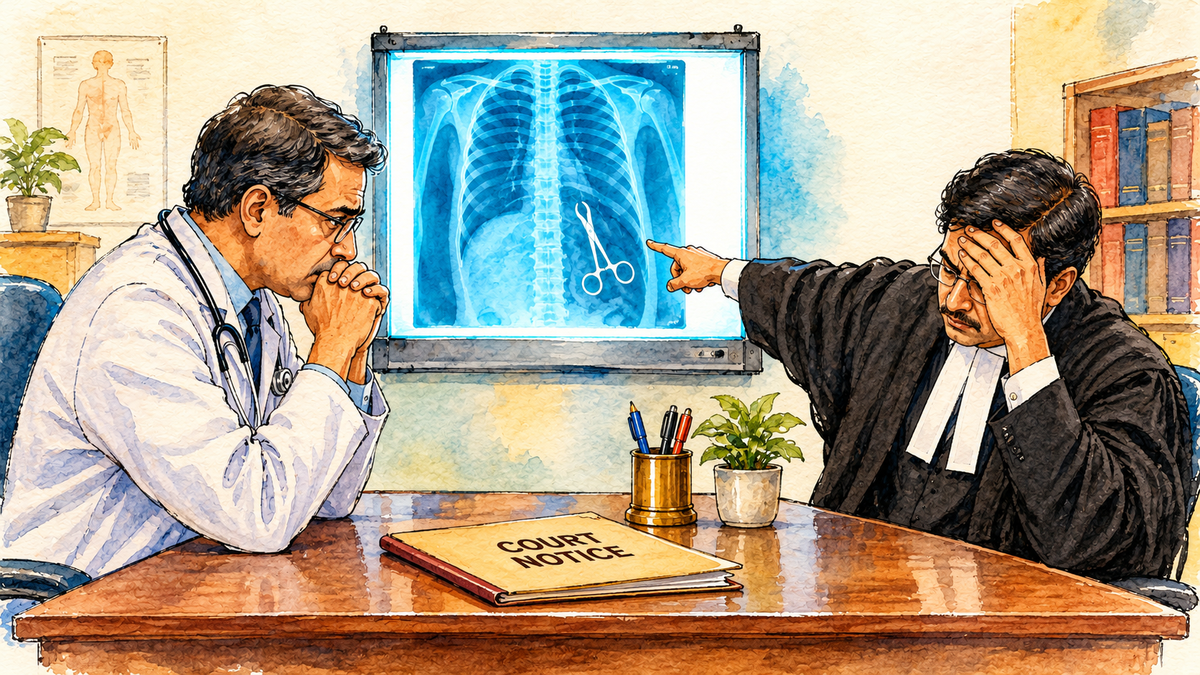
"I went into hospital to be cured of two stiff fingers. I have come out with four stiff fingers, and my hand is useless. That should not have happened if due care had been used. Explain it, if you can."
— Lord Denning LJ, Cassidy v Ministry of Health (1951)
A patient goes under anaesthesia for a routine operation and wakes up with a problem that was never on the consent form: a mop left in the abdomen, a ureter tied off during a hysterectomy. He was unconscious throughout. Every record, every instrument count, every name in that theatre is in the hands of the very people he is accusing. How is he to prove negligence?
The law's answer is a three-word Latin maxim: res ipsa loquitur, "the thing speaks for itself." It is one of the most powerful tools available to an injured patient, and, in the wrong hands, one of the most dangerous weapons against an honest doctor.
Key Takeaways
- Res ipsa loquitur allows negligence to be inferred from the nature of an injury, without the patient proving the exact negligent act.
- It applies only when the injury would not ordinarily occur without negligence, the doctor had exclusive control, and the patient contributed nothing.
- Once it applies, the doctor must offer an explanation consistent with due care, or face liability.
- The Supreme Court of India has warned that a failed treatment is not, by itself, proof of negligence.
- The maxim has no place in criminal prosecutions under Section 304A IPC (now Section 106 of the Bharatiya Nyaya Sanhita, 2023).
What the Maxim Means
- Res: the thing; the act or omission of the doctor in issue.
- Ipsa: itself; evidence so glaring that it permits an inference of negligence.
- Loquitur: speaks.
Ordinarily, the patient must prove every element of negligence (duty, breach, causation and damage) on a balance of probabilities, that is, "more likely than not." Duty is rarely difficult; once a doctor-patient relationship exists, a duty of care follows. Breach and causation are where claims live or die.
The maxim exists for the patient who, through no fault of his own, cannot explain how the injury happened, because that knowledge lies with the doctor. Where the breach is so obvious that the injury would not ordinarily occur without negligence, the facts do the talking, and the burden, exceptionally, moves to the doctor to show that he was not negligent.
Where It Began: A Falling Barrel
In Byrne v Boadle (1863) 2 H & C 722, a passer-by was struck by a barrel of flour that rolled out of the upper window of the defendant's warehouse. He could not say who had been careless, or how. He did not need to. Barrels do not fall out of windows by themselves, and the court held that the accident was, in itself, prima facie proof of negligence.
Replace the barrel with a surgical mop and the warehouse with an operation theatre, and the relevance to medicine is obvious.
The Essentials of the Maxim
1. The injury does not ordinarily occur without negligence
By common knowledge alone, one can conclude that such an injury would not happen with due care: a mop left in the abdomen, the wrong gas given during anaesthesia, a liver injured during an appendicectomy.
2. The doctor had exclusive control
The instrument of harm was under the doctor's exclusive control, so the injury was, more likely than not, the result of his negligence.
3. The patient did not contribute
There was no voluntary action or contribution by the patient. An unconscious patient on the operation table is the purest example.
4. The doctor's explanation does not account for the injury
If the doctor offers a non-negligent explanation that fully accounts for the injury, the inference falls away. If he cannot, it stands.
When the whole team is in the dock
What if the patient cannot say which member of the team was responsible? Courts have held the team collectively liable, since at least one of them had exclusive control. In the American case of Ybarra v Spangard, 25 Cal.2d 486 (1944), a patient woke from an appendicectomy with a paralysed shoulder. The surgeons, anaesthetist and nurses were each called upon to explain. None could. The silence of the theatre became the evidence against all of them.
The Maxim Enters Medicine: Cassidy v Ministry of Health
In Cassidy v Ministry of Health [1951] 2 KB 343, a patient went to hospital with two stiff fingers. He was operated upon and splinted, complained of pain, and was largely ignored for about fifteen days. When the splint came off, all four fingers were stiff and the hand was practically useless. The trial judge dismissed his claim.
The Court of Appeal reversed. Lord Denning held that the patient was not put to the impossible task of proving which doctor or nurse was negligent. He came in with two stiff fingers and went out with four, and the hospital had to explain it. It could not, and the appeal was allowed.
When the Maxim Does Not Apply
The maxim has no application where different inferences are reasonably possible, or where the cause of the injury is genuinely unknown.
In Mahon v Osborne [1939] 2 KB 14, a swab was left in a patient's abdomen; the surgeon had relied on the nurse's count. The Court of Appeal ordered a retrial. On one view, the surgeon was at least called upon to show that he had exercised due care to prevent the swab being left behind.
Scott LJ sounded a caution worth reading twice: a surgeon is not negligent merely because something went wrong. In medical cases, one can often say what went wrong but not what act caused it, and if the res is unknown, how can it speak for itself? For the maxim to operate, his reasoning suggests, there must be at least general medical evidence for the patient, sole control resting with the doctor, and an event that ordinarily does not happen without a want of care.
How Does a Doctor Defend Himself?
Once the maxim is invoked, the doctor is not condemned; he is called upon to answer. His defences are:
- An intervening cause. A known complication or inherent risk, not the doctor's conduct, caused the harm. Postpartum haemorrhage or disseminated intravascular coagulation can occur despite impeccable care.
- The patient's own contribution. The patient contributed to the injury, or knowingly accepted the risk.
- A plausible explanation consistent with due care. If the doctor shows how the injury could have occurred without negligence, the inference is neutralised.
What the doctor cannot do is simply shrug.
The Indian Position
Achutrao Haribhau Khodwa v State of Maharashtra (1996) 2 SCC 634
Chandrikabai was admitted to a government hospital in 1963 for a normal delivery and sterilisation. During that minor operation, a mop was left in her peritoneal cavity. Pus formed, a second operation followed, peritonitis set in, and she died.
The Supreme Court accepted that foreign bodies are sometimes left in the body without harm. But where one is left through want of care and suppurates, the conclusion is inescapable. She entered hospital for a simple delivery and never came out alive. In the absence of any valid explanation, the Court held the doctors negligent, observing that the doctrine clearly applied.
Jacob Mathew v State of Punjab (2005) 6 SCC 1
If Achutrao shows the maxim at full strength, Jacob Mathew draws its boundaries.
Even in civil cases, the Court warned, the maxim must be applied with extreme care and caution to doctors, or it becomes counterproductive. A doctor cannot be held liable merely because a patient did not respond to treatment or a surgery failed.
In criminal law, the Court was emphatic. The maxim is a rule of evidence belonging to the law of torts. The prosecution must prove negligence as an essential ingredient of the offence, and cannot do so by invoking this rule. A case under Section 304A IPC, now Section 106 of the BNS, cannot be decided solely by applying res ipsa loquitur. The doctor's liberty cannot hang on an inference the law treats as a civil convenience.
V. Kishan Rao v Nikhil Super Speciality Hospital (2010) 5 SCC 513
Here the Supreme Court drew on Michael Jones's treatise on Medical Negligence, which collects cases where the maxim has been applied:
- Burns, injections and instruments: a burn from electro-coagulation current — Clarke v Warboys (1952, CA); gangrene after an intramuscular injection — Cavan v Wilcox (1973) 44 DLR (3d) 42; a needle broken in the buttock — Brazier v Ministry of Defence [1965] 1 Lloyd's Rep 26.
- Surgical outcomes: facial paralysis after a radical mastoidectomy — Eady v Tenderenda (1974) 51 DLR (3d) 79; an undiagnosed known complication of hand surgery — Rietz v Bruser (No. 2) [1979] 1 WWR 31; a crippling post-operative infection left undiagnosed in a modern hospital — Hajgato v London Health Association (1982) 36 OR (2d) 669.
- Anaesthesia: brain damage from hypoxia in the recovery ward — Coyne v Wigan Health Authority [1991] 2 Med LR 301; a healthy girl in a permanent coma after a routine appendicectomy — Lindsey v Mid-Western Health Board [1993] 2 IR 147; spinal anaesthetic contaminated with disinfectant through faulty storage — Roe v Minister of Health [1954] 2 QB 66; an explosion during a routine anaesthetic technique — Crits v Sylvester (1956) 1 DLR (2d) 502.
- Delay: a 50-minute delay in obstetric help between twins, against an accepted maximum of 20 minutes — Bull v Devon Area Health Authority [1993] 4 Med LR 117.
The common thread: the patient could not know what went wrong, but the outcome itself was eloquent enough.
Conclusion
Res ipsa loquitur is the law's acknowledgement that an unconscious patient cannot witness his own injury, and those who hold all the knowledge should not hide behind his ignorance. When a mop is found in an abdomen, or two stiff fingers become four, the law rightly says to the doctor: explain it, if you can.
But the maxim is a shield for the helpless, not a sword for the disappointed. Medicine is not an exact science, and a bad outcome is not the same as a negligent one. The honest doctor's best protection remains meticulous care, careful counts, contemporaneous notes, and the willingness to explain. Because when negligence is real, it rarely stays hidden. As the Gujarati proverb puts it, Paap chhapre chadi ne pokare: sin climbs to the rooftop and shouts!
About the Author
Dr. Mahendra K. Joshi, M.S. (General Surgery), LL.M. (Criminology), M.A.S.L.M.E. (USA)
Ex. Member, State Consumer Commission — Gujarat
[email protected] | +91 98790 94226