Prescription: More Than a Piece of Paper
A prescription is the most common weapon in a doctor's hands and the most neglected. When treatment goes wrong, it becomes documentary evidence in court. This article covers what it must contain, what the Code of Ethics requires, and when it proves negligence.
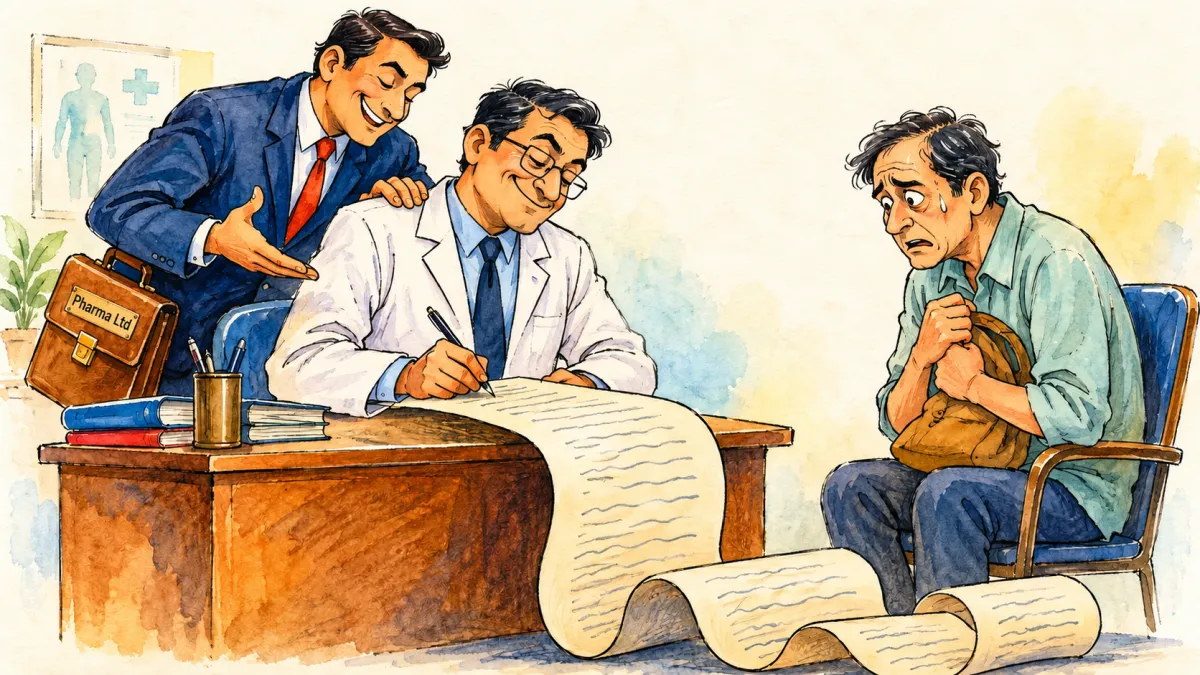
"Wherever the art of Medicine is loved, there is also a love of Humanity."
— Hippocrates
A doctor's career begins with writing a prescription, and over a lifetime of practice he writes innumerable ones. It is the most common weapon used to treat a patient, and it is also the most neglected. Most doctors scribble it in seconds. Few stop to ask what it will mean if it is ever placed before a court.
The most important medico-legal aspect of a prescription is that it is documentary evidence. It proves or disproves the doctor-patient relationship, the dose, the advice given and the care taken. When a case of medical negligence reaches a Consumer Commission or a court, the prescription is often the first exhibit, and sometimes the only one.
Key Takeaways
- "Rx" comes from the Latin recipe, meaning "take". The folk theory linking it to the symbol of Zeus or Jupiter is only a legend.
- A prescription is documentary evidence. It shows that the prescriber takes responsibility for the patient's clinical care.
- It should record the history, clinical findings, diagnosis, investigations, medicines and all advice, so that the doctor can assess the patient on the next visit.
- In Poonam Verma v. Ashwin Patel (1996) 4 SCC 332, the Supreme Court dealt with a practitioner prescribing outside his own system of medicine, and the case remains a landmark on negligence.
- Where possible, drugs should be prescribed by generic name, legibly and rationally, in line with the Code of Ethics.
- Prescribing without examining the patient, ignoring a report, or prescribing steroids or psychotropic drugs without absolute indication can amount to negligence or gross professional misconduct.
- A prescription must be understood by the patient. In a country where prescriptions are written in English and most patients do not read it, explaining it is the prescriber's duty.
The Meaning of "Rx"
"Rx" is a symbol that originated in medieval manuscripts as an abbreviation of the Late Latin verb recipe, meaning "take". According to "folk" theories, it is the ancient symbol of the gods, Zeus or Jupiter. Whatever its origin, the symbol is a fitting one. A prescription is an instruction, and an instruction carries authority and responsibility.
What Exactly Is a Prescription?
The dictionary meaning is simple: an instruction from a prescriber to a dispenser. For academic purposes, it is defined as a health-care programme that governs the plan of care for an individual patient and is implemented by a qualified practitioner.
The law reads it more strictly. A prescription indicates that the prescriber takes responsibility for the clinical care of the patient. As medical practice has grown more complex, the meaning of the term has broadened. Today it includes:
- the patient's complaints
- clinical findings
- investigation reports
- advice about investigations
- diet, exercise and anything else relevant to the safety or efficacy of treatment
Why the Prescription Matters in Law
A prescription is not just a piece of paper. It is meant to show the entire outdoor (OPD) treatment at a glance and to make it easy to monitor the patient. For that reason, the doctor should endorse the history, examination findings, medicines and all advice.
If this data is not on the prescription, how will the doctor assess the patient's condition on the next visit? And how will he defend himself if the treatment is ever questioned?
The Supreme Court considered the duty of a medical practitioner in Poonam Verma v. Ashwin Patel (1996) 4 SCC 332. The case concerned a practitioner trained in homoeopathy who treated a patient with allopathic drugs. It is relevant here because it shows how closely a prescription is examined once treatment goes wrong. The prescription showed what was given and on whose authority, so the Court could judge the treatment against the practitioner's qualification.
The author's view is that it is now accepted medical practice for doctors to write down the history, findings, diagnosis, tests and advice on the prescription itself. Almost every doctor who wants a pathological test done advises it in writing on the prescription. A breach of this duty can be treated as negligence.
What a Good Prescription Should Contain
A prescription that will stand up to scrutiny should carry:
- The doctor's name, designation and registration particulars
- The patient's name, age and sex
- The date
- The history and clinical findings
- The diagnosis, or at least a provisional one
- The investigations advised
- The medicines, with dose, route, frequency and duration
- Advice on diet, exercise and follow-up
- The doctor's signature
Prescriptions with these entries protect the patient, because the next doctor can follow them. They also protect the doctor, because they are a contemporaneous record of what was done and why.
The Patient Must Understand It
In our country, prescriptions are written in English, and most patients do not know English. It is therefore also the prescriber's duty to see that the patient has understood the prescription properly. That means the medicine, the dose, the timing, the warning signs and the date of review.
A prescription that the patient cannot read, or that the pharmacist misreads, has failed in its purpose. It is well known that doctors' handwriting is often illegible. The author's view is that illegibility is not a joke or a harmless habit. A prescription that cannot be read may amount to negligence, because a wrong drug or a wrong dose can follow from it.
What the Code of Ethics Says
The Medical Council of India Code of Ethics Regulations, 2002 (amended up to 2010) sets out the professional standard. The Council has since been replaced by the National Medical Commission. The provisions relevant to prescriptions are as follows.
Use of Generic Names (Clause 1.5)
Every physician should, as far as possible, prescribe drugs with generic names. He or she must also ensure that the prescription and the use of drugs are rational.
Name and Registration (Clause 3.7.2)
A physician shall write his name and designation in full, along with registration particulars, on the prescription letterhead. In a Government hospital where the patient load is heavy, the name of the prescribing doctor must be written below his or her signature.
Secret Remedies (Clause 6.5)
Prescribing or dispensing secret remedial agents whose composition the physician does not know is unethical and prohibited. All drugs prescribed by a physician should carry a proprietary formula and a clear name.
Drugs and Cosmetics Act (Clause 7.8)
A registered medical practitioner shall not contravene the Drugs and Cosmetics Act or its regulations. Two acts in particular constitute gross professional misconduct:
- prescribing steroids or psychotropic drugs when there is no absolute medical indication
- selling Schedule "H" and "L" drugs and poisons to the public, except to his own patient
Advertising on the Prescription
It is unethical to advertise on a prescription. It also goes without saying that drugs cannot be prescribed without seeing the patient.
A Note on the 2023 Regulations
In August 2023 the National Medical Commission notified new professional conduct regulations. They required prescribing by generic name and restricted dealings with pharmaceutical companies. Within weeks they were held in abeyance after strong objections. The Commission then made the 2002 Regulations effective again. Those 2002 provisions are what practising doctors are still expected to follow.
Guidelines for Prescribers and Pharmacists
The Indian Medical Association has published guidelines (2024) for prescribers and pharmacists.
Doctors should:
- prescribe drugs by generic name, if possible, in legible capital letters
- ensure that prescriptions are rational and use drugs appropriately
- not use touts or agents to get patients
Pharmacists should:
- verify the prescription's completeness, authenticity and legality
- ensure that the prescription is from a doctor registered with the MCI or a State Medical Council
- ensure that the prescription carries the doctor's registration number
- not dispense more than the quantity prescribed
- not allow doctors to display their signboards in their shops
The Generic Names Dilemma
The rule that doctors should prescribe generic names sounds simple and noble. The hard reality is that the majority of doctors still do not use generic names. The reasons are not hard to find.
- The doctor's side. A doctor who writes a brand name can oblige his favourite pharmaceutical company and receive a reward. A generic name gives him nothing to oblige.
- The chemist's side. When doctors write generic names, the power of choosing the company passes to the medical stores, and they have their own favourites.
- The inspector's side. Everybody knows that, in the end, the Drug Inspectors stand to benefit from the confusion.
- The remedy. The Government should develop a system of checks, with chains of accountability, to curb the practice of pharmaceutical companies, medical stores and doctors taking advantage of this regulation.
- The victim. The poor patient is the sufferer, and nobody bothers.
A rule that only changes who collects the commission has not helped the patient. Real reform must put the patient's interest, in quality and in price, at the centre.
When a Prescription Becomes Evidence of Negligence
Because it is documentary evidence, the prescription can prove or disprove many facts. The following examples show how it is used:
- The doctor-patient relationship. A prescription is proof that the doctor undertook the patient's care.
- Overdose of a drug. The dose written is the dose the doctor ordered.
- Report ignored. If the investigation report was available and the prescription does not reflect it, the doctor can be said to have ignored it.
- No investigation advised. The absence of a necessary test on the prescription is evidence that it was not advised.
- No watch for reaction. If follow-up and warning signs are not recorded, the doctor may be said to have failed to watch for a reaction.
- Prescribing without examination. A prescription with no findings suggests that no examination was done.
- Injecting without applying mind. The drug given must match a reasoned prescription.
- Administration not matching the prescription. If what was given differs from what was written, the difference is itself a ground of negligence.
Conclusion
A prescription is not just a piece of paper. It is meant to give the entire outdoor treatment at a glance and to make it easy to monitor the patient. The doctor should therefore record the diagnosis, age, history, clinical findings, investigations and all advice, and should set out every test required.
It is known that doctors' handwriting is often illegible, but when that illegibility puts the patient at risk, it amounts to negligence. A well-written prescription is the doctor's best defence, and a careless one is his most damaging admission.
As the physician writes, so shall he be judged.
About the Author
Dr. Mahendra K. Joshi, M.S. (General Surgery), LL.M. (Criminology), M.A.S.L.M.E. (USA)
Ex. Member, State Consumer Commission — Gujarat
[email protected] | +91 98790 94226